'Quiet' cars on trains -- where cell phones and loud headphones are banned -- are widely popular. So why aren't more transit agencies making designated quiet cars?


"Numerous public opinion surveys find that people are irritated by being around the cell phone calls of others. Recognizing this fact, Amtrak has created a "quiet car" on their Acela Express. The car is for those passengers who refrain from using their cell phone and those who want to avoid people who cannot.
The cell phone-free train car is not a concept limited to Amtrak. The French national railway provides something called the "Zen car," which is designed to encourage serene travel. No cell phone talking allowed. Recently, Graz, Austria announced that it would be implementing a similar tranquil carriage in their city system. And the subways of Germany go even further: signage asks riders to keep their MP3 players turned down so that the music leaking from earbuds will not irritate other riders.
Given the degree of civility shown on these and many other mass-transit systems, it seems high time for the Long Island Railroad and New Jersey Transit to adopt similar arrangements so that their riders can also enjoy cell phone-free train cars."
Read the full story: The Power of Quiet

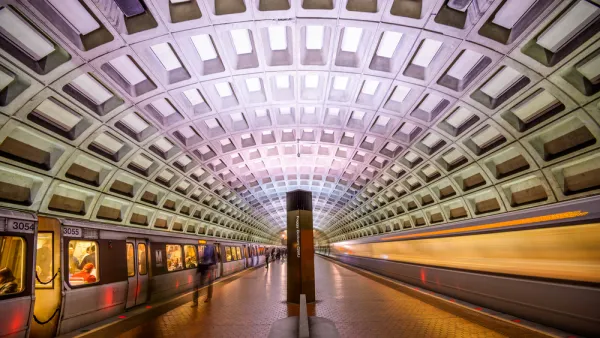
Where Have D.C.'s Metro Riders Gone?
Following an 11 percent drop in ridership in the last quarter, transportations experts are left scratching their heads as to where D.C.'s Metrorail riders have gone.

Strategies for Maximizing Transit Ridership
Jarrett Walker outlines the conditions under which transit serves the greatest number of travelers. Maximizing ridership, he argues, requires thinking like a business and catering to demand.

Trump Administration Proposes to Divert Billions from Mass Transit to Highways; Advocates Sound Alarm
Two proposals from the Trump DOT would eliminate a federal mass transit fund and make it harder for states to allocate funding to transit projects.

Planetizen Federal Action Tracker
A weekly monitor of how Trump’s orders and actions are impacting planners and planning in America.

Amtrak, CN end decades-long dispute with eight-year agreement
The new operating agreement establishes an updated framework for the companies to work together, including processes to resolve disputes.

Judges permit Denver to divert 77,000 acre feet from the Colorado River for reservoir expansion
Overuse and climate change have caused the Colorado River’s water levels to plummet.

NYC DOT wants faster, more permanent street upgrades
The city is examining ways to build more concrete infrastructure without getting entangled in 'decades-long' projects.

'Something we’ve never seen before:' rising utility rates could strain city finances nationwide
Data centers, climate change and other factors have caused utility rates in the United States to increase by 38% since 2020.

Trump to overrule local leaders, lease millions of acres of America’s Pacific Island territories’ seafloors to mining companies
International law says that the Indigenous people of America’s territories have a right to prior and informed consent regarding projects that impact their countries.

FREE Course: Walkable City 1: Why Walkability?
After describing his path towards focusing on walkability as the essence of good planning, Jeff Speck marches through his five principal reasons for making more walkable places.
Reinventing Malls: Planning Alchemy—Turning Gray Fields Into Gold
The course focuses on the opportunities and imperatives that shape reinvention of mall sites.

Harvard University Graduate School of Design
KFH Group Inc.
Greater Baltimore Committee
The Architects Foundation
University of Cincinnati Online
The Pocatello Development Authority
The Urban Renewal Agency of the City of Pocatello