After more than three hours of public comment and debate at Thursday's MTA Board meeting, the Board of Directors approved placing a half-cent sales tax on the November ballot, pending approval of a companion Assembly bill.


"The Metropolitan Transportation Authority board on Thursday voted overwhelmingly to seek a half-cent-on-the-dollar sales tax increase that could raise $30 billion to $40 billion for transit and highway projects, including the first link of a long-awaited subway to the sea.
The 13-member board's action, approving a ballot measure for the Nov. 4 election, is a major step that could lead to construction of several dozen transportation projects in the county over the next three decades.
Before the measure can be placed on the ballot, the Legislature must authorize it, which Los Angeles Mayor Antonio Villaraigosa says he is confident will happen soon. A bill, AB 2321, by Assemblyman Mike Feuer (D-Los Angeles) is pending in the Senate.
'This is a historic moment,' Feuer told the MTA board before the vote. 'We know our residents are calling on us to seize this moment. This is an opportunity that won't come again, not for a generation.'"
Read the full story: MTA votes to seek sales tax hike to fund L.A. County transit, roads
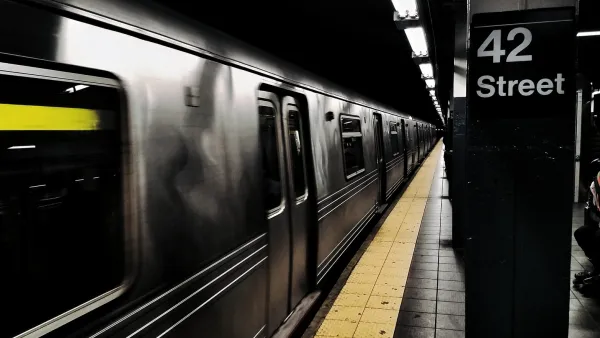
Op-Ed: NYC Transit Service Cuts Wrong Way to Bolster Budget
The agency could see an influx of capital funds from congestion pricing, but cuts to bus and rail service to make up for budget shortfalls would result in long-term setbacks to the system.
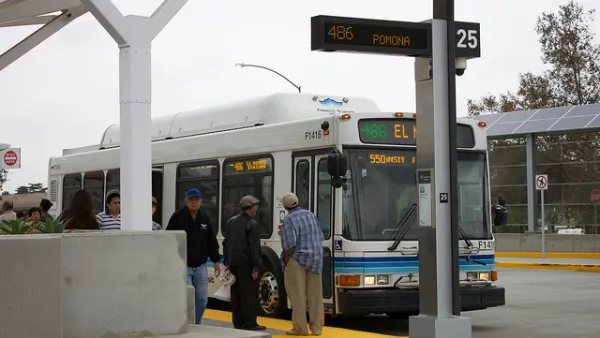
Local Buses Among the First to Benefit from L.A. County's Measure M
Fifteen municipal or regional bus services in Los Angeles County that receive funding from the Los Angeles County Metropolitan Transportation Authority will be among the first to benefit from a newly approved transportation sales tax.
How High is Too High for Transportation Sales Taxes?
Sales taxes are regressive, but unlike the gas tax, they bear no relationship to transportation. Should a November transportation ballot measure pass, sales taxes in three cities in the county of Los Angeles would exceed 10 percent.

Planetizen Federal Action Tracker
A weekly monitor of how Trump’s orders and actions are impacting planners and planning in America.

Eastern Nebraska is running out of electricity
Data centers and electrification are straining eastern Nebraska’s grid, throttling economic development.

Study reveals best places in the U.S. for cycling, walking
New research from Streetlight Data examines bicycle and pedestrian miles per capita in the 100 largest U.S. cities by population.

DSA members accuse Mamdani of 'abandoning values' over housing redevelopment
New York City's mayor plans to replace about 2,000 units of public housing with private, mixed-income housing.

All sides of BRT debate unhappy with CDOT’s most recent move
The Colorado Department of Transportation is no longer considering center-running bus lanes for Colorado Boulevard.

Massachusetts bogs generate both power, and cranberries
Putting solar panels above farmland is one way Massachusetts is advancing toward its goal of net-zero carbon emissions by 2050.

FREE Course: Walkable City 1: Why Walkability?
After describing his path towards focusing on walkability as the essence of good planning, Jeff Speck marches through his five principal reasons for making more walkable places.
Reinventing Malls: Planning Alchemy—Turning Gray Fields Into Gold
The course focuses on the opportunities and imperatives that shape reinvention of mall sites.

City of Rosemead
Rutgers University, Edward J. Bloustein School of Planning and Public Policy
One Hundred Miles
University of Michigan School for Environment and Sustainability (SEAS)
Hunter College, City University of New York (CUNY)
The Architects Foundation
City of Cambridge
The Pocatello Development Authority
The Urban Renewal Agency of the City of Pocatello