The annual transformation of riverbanks to beaches has begun in Paris, where the River Seine becomes a widely visited outdoor public space known as Paris Plages.


"It is pure hedonism to want to transform a capital city into a seaside resort, bringing 2,000 tons of sand by boat, displaying more than a thousand deckchairs on its river banks, loaning 85 boats for people to sail for free, planting 950 trees in a single square and building 61 beach cabins on what is, for 335 days of the year, an expressway."
"The scheme has been expanded this summer to include more free activities, more palm trees, more concerts, more sand and more bamboo forest; and is about to be launched in many new Parisian locations."
"Aside from its original location on the Right Bank, from Pont Henri IV to Quai du Louvre, this year sand and entertainment can also be found in waterside spaces in the north-east of the French capital, along the three canals that lead up to the Villette basin, and from La Villette into various suburban towns."
"Paris Plages started life as a socialist fantasy: bring the beaches to those who can't afford summer holidays and create a bit of joie de vivre for the millions of tourists who make Paris the most visited city in the world."
Read the full story: Sun, Seine and sand
Paris to the People
Angelique Chrisafis delivers the fantastic news that, after more than four decades of auto dominance, Paris is returning its riverfront to its people in a "pedestrian 'reconquest' of the banks of the Seine."
Battle Over Closure of Paris Expressways
A political battle is brewing in Paris, where the city's mayor wants to close off sections of roadway along the River Seine, a move that President Nicholas Sarkozy is against.
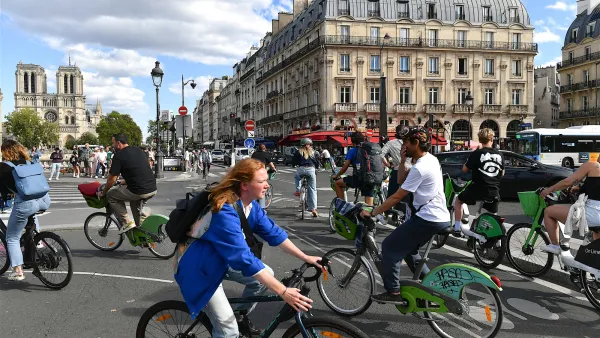
Biking in Paris grew by 240% in 5 years
The city saw a significant rise in bike use thanks to data-driven policy changes.

Planetizen Federal Action Tracker
A weekly monitor of how Trump’s orders and actions are impacting planners and planning in America.

California plans to bury El Niño’s downpour
If the state plays its cards right, it may be able to store a billion acre-feet of El Niño’s water in aquifers.

Desperate measures: Advocates weigh draining Lake Powell to fill Colorado River
Draining the reservoir could reduce evaporation losses by a couple hundred thousand acre-feet.

Study reveals best places in the U.S. for cycling, walking
New research from Streetlight Data examines bicycle and pedestrian miles per capita in the 100 largest U.S. cities by population.

Los Angeles just elected an urban planner as its mayor
Transportation analysts are optimistic that Raman will be more aggressive in addressing transit issues than Bass.

Mamdani’s pied-à-terre tax survives legal challenge
A panel of judges found that the plaintiffs failed to demonstrate injury as a result of New York City's implementation of the tax.

FREE Course: Walkable City 1: Why Walkability?
After describing his path towards focusing on walkability as the essence of good planning, Jeff Speck marches through his five principal reasons for making more walkable places.
Reinventing Malls: Planning Alchemy—Turning Gray Fields Into Gold
The course focuses on the opportunities and imperatives that shape reinvention of mall sites.

City of Rosemead
Rutgers University, Edward J. Bloustein School of Planning and Public Policy
One Hundred Miles
University of Michigan School for Environment and Sustainability (SEAS)
Hunter College, City University of New York (CUNY)
The Architects Foundation
City of Cambridge
Montrose County
The Pocatello Development Authority