Cities across the world are rising higher and beefing up their skylines with high-profile skyscrapers. A building boom in emerging global cities has put a new face on the battle for the best skyline.


"Economically booming megacities -- such as Beijing, Shanghai and Dubai -- where extravagant skyscrapers are shooting up all over, mean that cities like New York are beginning to look old and outdated, despite attempts to modernize. In Europe, the eastern part is beginning to look more modern than the western part. Cities like Istanbul and Moscow are more dynamic than London, Paris or Milan."
"There have never been this many skyscrapers on the drawing boards, with most of them planned for the world's new boom towns. The West is eying this development with jealousy, all the more intense for its inability to compete. The massive downturn in the American credit market has caused the cancellation or postponement of many major architectural and urban-planning projects."
"The battle for the best skyline, which has been underway for more than 100 years, is entering a new round. And it already seems to be clear who the winners will be: the Middle East and the Far East. Kazakhstan and Qatar could soon be aesthetically more dominant than Europe or the United States. It is an architectural clash of civilizations. One of the most ironic aspects of this development is that, in many cases, it is the West's leading architects who are driving this transition. Working for newly enriched governments and real estate tycoons, they are now being given free reign to do what would now be inconceivable in their home countries."
Read the full story: The Battle for the World's Skyline
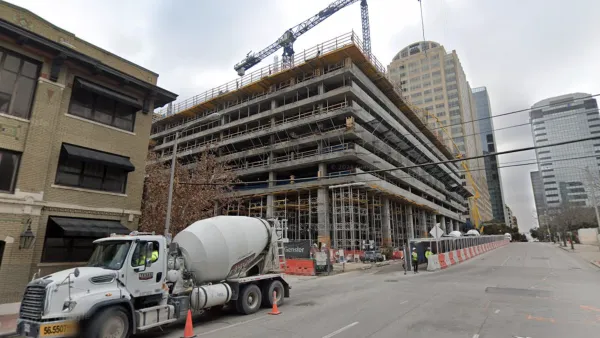
Austin's Tallest Tower Rising Quickly
Sixth and Guadalupe, which will top out at 875 feet, will soon be crowned the tallest building in Austin, and the fifth-tallest building in Texas.
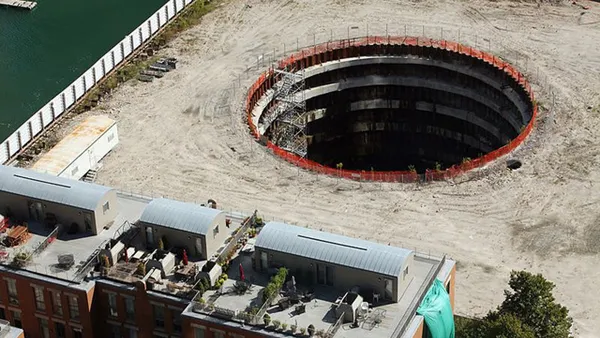
Two Skyline Changing Apartment Towers Proposed to Rise on the Site of Chicago's Failed Spire
An infamous site has new development life after developers returned to the public with a revised project proposal.
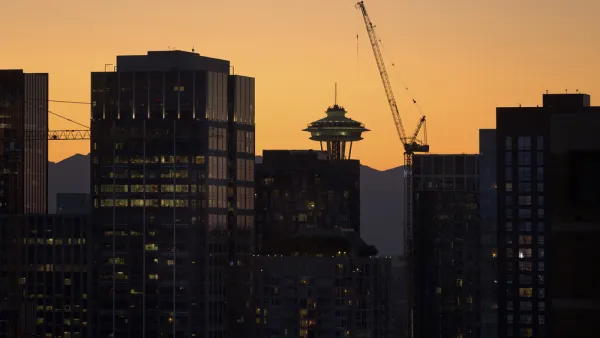
Tracking the Skyward Progress of Western U.S. Cities
A Washington Post feature analyzes the changing skylines of cities from the Rocky Mountains to the Pacific Ocean.

Planetizen Federal Action Tracker
A weekly monitor of how Trump’s orders and actions are impacting planners and planning in America.

California plans to bury El Niño’s downpour
If the state plays its cards right, it may be able to store a billion acre-feet of El Niño’s water in aquifers.

Desperate measures: Advocates weigh draining Lake Powell to fill Colorado River
Draining the reservoir could reduce evaporation losses by a couple hundred thousand acre-feet.

Los Angeles just elected an urban planner as its mayor
Transportation analysts are optimistic that Raman will be more aggressive in addressing transit issues than Bass.

Mamdani’s pied-à-terre tax survives legal challenge
A panel of judges found that the plaintiffs failed to demonstrate injury as a result of New York City's implementation of the tax.

Eastern Nebraska is running out of electricity
Data centers and electrification are straining eastern Nebraska’s grid, throttling economic development.

FREE Course: Walkable City 1: Why Walkability?
After describing his path towards focusing on walkability as the essence of good planning, Jeff Speck marches through his five principal reasons for making more walkable places.
Reinventing Malls: Planning Alchemy—Turning Gray Fields Into Gold
The course focuses on the opportunities and imperatives that shape reinvention of mall sites.

City of Rosemead
Rutgers University, Edward J. Bloustein School of Planning and Public Policy
One Hundred Miles
University of Michigan School for Environment and Sustainability (SEAS)
Hunter College, City University of New York (CUNY)
The Architects Foundation
City of Cambridge
Montrose County
The Pocatello Development Authority