New York City is trying to make life for bike commuters a little less treacherous by building dedicated bike lanes throughout the city.


"The view from the lens of photographer Mark Weiss's camera is of a treacherous world of cab drivers weaving into bike lanes, of double-parked delivery vehicles, of car doors opening suddenly, of pedestrians wandering blindly and of narrow passageways between trucks. It is the world of the Manhattan bicycle commuter, which Weiss captures on a camera affixed to a bar on his single-gear bike."
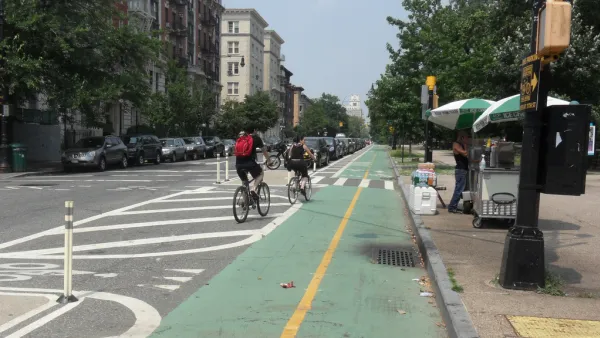
"City officials, hoping to make commutes like his less treacherous, have created a seven-block experiment of a bike lane on Ninth Avenue. Here, concrete dividers and a row of parked cars shield a bike lane from the street and its traffic. Low mini-traffic lights show when cyclists have the right of way. Bike commuters, messengers and delivery people peel down perfectly smooth paths."
"The city is planning to create another protected lane on Eighth Avenue, part of an effort to encourage cycling in New York, where bike use has increased by 75 percent since 2000, to about 130,000 commuters a day. The city hopes to double current bicycle use by 2015 and to triple it by 2020."
Thanks to Streetsblog
Read the full story: N.Y. Hopes to Ensure Smooth Pedaling for Bike Commuters
Responding to Bike Improvement Skeptics
Communities can receive high economic returns from appropriate bicycle facility invesments. It is important that advocates have solid arguments for responding to skeptics.
Surveying the Weakest Arguments Against Bike Lanes
According to a recent newspaper editorial, "Egged on by the hardcore enthusiasts, New York City is spending lots of money, confiscating lots of lane-miles and basing its transportation policy on a fantasy." Who knew white paint is so threatening?
Got Protected Bike Lanes?
While Angie Schmitt doesn't ask this question in her article on the movement behind these lanes, she writes that cities without them "are being left behind". They're popular because they effectively address the #1 reason for not riding: safety

Planetizen Federal Action Tracker
A weekly monitor of how Trump’s orders and actions are impacting planners and planning in America.

California plans to bury El Niño’s downpour
If the state plays its cards right, it may be able to store a billion acre-feet of El Niño’s water in aquifers.

Desperate measures: Advocates weigh draining Lake Powell to fill Colorado River
Draining the reservoir could reduce evaporation losses by a couple hundred thousand acre-feet.

Los Angeles just elected an urban planner as its mayor
Transportation analysts are optimistic that Raman will be more aggressive in addressing transit issues than Bass.

Mamdani’s pied-à-terre tax survives legal challenge
A panel of judges found that the plaintiffs failed to demonstrate injury as a result of New York City's implementation of the tax.

Eastern Nebraska is running out of electricity
Data centers and electrification are straining eastern Nebraska’s grid, throttling economic development.

FREE Course: Walkable City 1: Why Walkability?
After describing his path towards focusing on walkability as the essence of good planning, Jeff Speck marches through his five principal reasons for making more walkable places.
Reinventing Malls: Planning Alchemy—Turning Gray Fields Into Gold
The course focuses on the opportunities and imperatives that shape reinvention of mall sites.

City of Rosemead
Rutgers University, Edward J. Bloustein School of Planning and Public Policy
One Hundred Miles
University of Michigan School for Environment and Sustainability (SEAS)
Hunter College, City University of New York (CUNY)
The Architects Foundation
City of Cambridge
Montrose County
The Pocatello Development Authority