While Americans have not turned to the bicycle as a mode of transportation in the same numbers seen elsewhere in the world, some predict that soaring gas prices and increased infrastructure investments could change that.


"It's U.S. National Bike to Work Day on Friday and Americans are facing record high gasoline prices, but most commuters will stick to their cars. The combination of gas near $4 a gallon and the annual campaign to get people to pedal to work may prompt a few more people than usual to commute on two wheels.
But the majority won't consider the bicycle as a regular means of transport because they simply have too far to go and feel nervous about riding on traffic-choked streets, bicycling advocates and dedicated motorists say.
According to the National Sporting Goods Association, the number of Americans who bike 'frequently' -- 110 days a year or more -- fell almost 10 percent in 2007 to 3.7 million people.
Similarly, the number of people who ride bikes at least six times a year fell to 35.6 million in 2006, the lowest since the survey began in 1984, from 56.3 million in 1995.
Still, American bicycle advocates said there are signs the trend could be reversed, prompted most recently by gas prices, and by concerns over climate change, air pollution, energy security and personal health.
Some American cities including Portland, Oregon, and Washington have higher rates of bike use than the national average thanks to bike-friendly infrastructure."
Read the full story: Americans leery of bicycles despite gas price jump
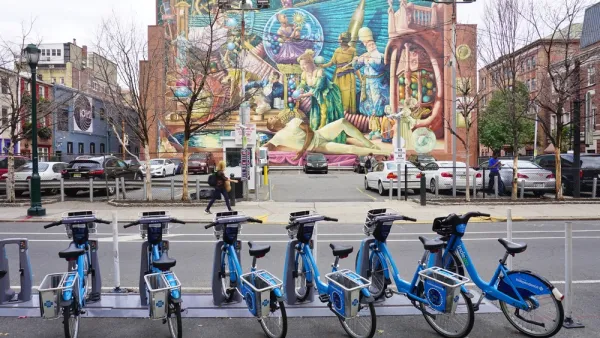
Checking in on Philadelphia's Promised Protected Bike Lanes
Philadelphia Mayor Jim Kinney is discovering on the job that planning is much easier than delivering when it comes to protected bike lanes—as is the case in many cities around the country.
Wanted: Six Cities Yearning to be Bike Friendlier!
For cities that want protected bike lanes but lack the expertise to implement them, the Green Lane Project is soliciting applications to offer technical help (sorry, no funding) now that the initial six recipient cities have implemented cycle tracks.
How Protected Bike Lanes Benefit Businesses
Can your city afford not to install protected bike lanes? Michael Andersen previews a coming report from the bike lane advocacy organization Green Lane Project and the Alliance for Biking and Walking that shows how such lanes help local businesses.

Desperate measures: Advocates weigh draining Lake Powell to fill Colorado River
Draining the reservoir could reduce evaporation losses by a couple hundred thousand acre-feet.

Eastern Nebraska is running out of electricity
Data centers and electrification are straining eastern Nebraska’s grid, throttling economic development.

Move over, LA: St. Louis gears up for Olympics, invests millions in downtown redevelopment
The Missouri city will host the 2028 Olympic soccer group stage and knockout matches.

‘No clear next steps’ for Chicago's permanent festival grounds
Eleventh Ward Ald. Nicole Lee has suggested Soldier Field as a possible location for the permanent event space.

California, Hawaii, Rhode Island approve housing propositions
Hawaii and Rhode Island each approved their sole proposition, while California approved two of its three.

Officials claim feds 'rushed' Amtrak environmental review
Amtrak plans to move their Chicago maintenance facility from an industrial area to a residential one.

FREE Course: Walkable City 1: Why Walkability?
After describing his path towards focusing on walkability as the essence of good planning, Jeff Speck marches through his five principal reasons for making more walkable places.
Reinventing Malls: Planning Alchemy—Turning Gray Fields Into Gold
The course focuses on the opportunities and imperatives that shape reinvention of mall sites.

City of Rosemead
Rutgers University, Edward J. Bloustein School of Planning and Public Policy
One Hundred Miles
University of Michigan School for Environment and Sustainability (SEAS)
Hunter College, City University of New York (CUNY)
The Architects Foundation
City of Cambridge
Montrose County
The Pocatello Development Authority