Can your city afford not to install protected bike lanes? Michael Andersen previews a coming report from the bike lane advocacy organization Green Lane Project and the Alliance for Biking and Walking that shows how such lanes help local businesses.


"As almost any bike advocate will tell you, a bike isn't a toy; it's a tool. And by the same token, it's becoming clear to more and more politicians and businesspeople that a protected bike lane isn't a luxury that cities install if they can afford to," writes Andersen. "When they're used right, protected bike lanes are part of the path to prosperity."
He goes on to explain the four key ways that businesses benefit from such lanes:
- Protected bike lanes increase retail visibility and volume.
- Protected bike lanes make workers healthier and more productive.
- Protected bike lanes make real estate more desirable.
- Protected bike lanes help companies score talented workers.
Read the full story: HERE ARE THE 4 WAYS PROTECTED BIKE LANES HELP LOCAL BUSINESSES
Wanted: Six Cities Yearning to be Bike Friendlier!
For cities that want protected bike lanes but lack the expertise to implement them, the Green Lane Project is soliciting applications to offer technical help (sorry, no funding) now that the initial six recipient cities have implemented cycle tracks.
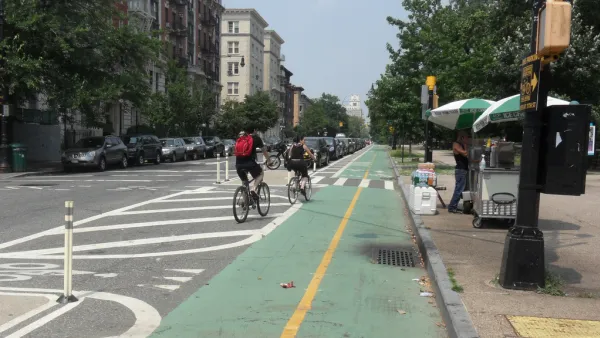
Got Protected Bike Lanes?
While Angie Schmitt doesn't ask this question in her article on the movement behind these lanes, she writes that cities without them "are being left behind". They're popular because they effectively address the #1 reason for not riding: safety
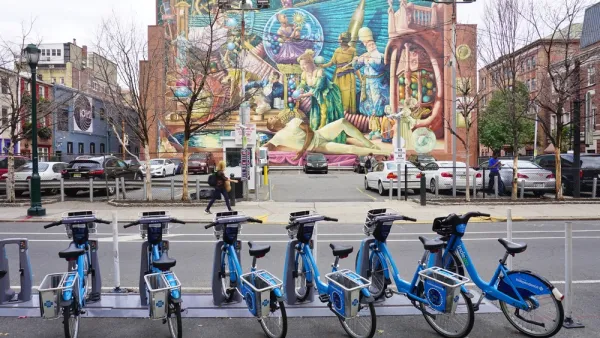
Checking in on Philadelphia's Promised Protected Bike Lanes
Philadelphia Mayor Jim Kinney is discovering on the job that planning is much easier than delivering when it comes to protected bike lanes—as is the case in many cities around the country.

Planetizen Federal Action Tracker
A weekly monitor of how Trump’s orders and actions are impacting planners and planning in America.

Washington state to charge fee to drivers with fuel-efficient cars
Revenue from the fee will go towards supporting the state’s highways.

Trump to blast ‘hydrocarbon highway’ through ‘world’s longest art gallery’
Environmental and historic preservation groups are suing to stop the project.

22-mile pedestrian and bike path to encircle Atlanta by 2030
The project will also support affordable housing.

Army detonates nearly 5 tons of lead in Iowa
The detonation comes after days of delays and public outcry.

Golden Girls bills could bring together older and younger roommates
In more than 30 states, local laws can restrict how many unrelated people can share a home.

FREE Course: Walkable City 1: Why Walkability?
After describing his path towards focusing on walkability as the essence of good planning, Jeff Speck marches through his five principal reasons for making more walkable places.
Reinventing Malls: Planning Alchemy—Turning Gray Fields Into Gold
The course focuses on the opportunities and imperatives that shape reinvention of mall sites.

City of Charlotte
City of Rosemead
Rutgers University, Edward J. Bloustein School of Planning and Public Policy
University of Michigan School for Environment and Sustainability (SEAS)
Hunter College, City University of New York (CUNY)
The Architects Foundation
University District Partnership