A Los Angeles activist and artist has taken to placing street signs mimicking the city's no parking signs on traffic islands, declaring them parks.


"It could very well be a mirage: A trick of the glaring morning sun or something misread in the pre-caffeinated early morning haze.
But no. Upon closer inspection, that brown-and-white sign, hanging just beneath the red slash of the "No Left/U-Turn" symbol on a sparsely landscaped traffic island, proclaims exactly what you first thought: "The Islands of LA Nat'l Park."
The territory it demarcates along a busy stretch of Glendale Boulevard as it eases into Echo Park seems, at first, unremarkable: some California native brush; flattened and faded Diet Coke cans; Energizer batteries. Nearby, vibrant goldenrod poppies push up from the dirt. And sure, depending on the time of day, you'll find a few regular "campers" -- a couple of reliably resolute panhandlers: one with a dog, another alone and with his own sign whose message has become garbled, streaked and bloated from rain.
National park? Even park would seem a stretch.
Yet the sign is not a movie ad. Nor part of a clever labeling scheme for city districts. Nor is it a joke. Provocative and whimsical, it's a prompt meant to take the mind down a side road that's often as invisible as the traffic island itself. It's an invitation: " 'Come travel here in this idea,' " says artist and activist Ari Kletzky, who since last fall has been placing signs across greater Los Angeles -- both "Islands of LA" and another, "Shift: Do Art Any Time," that mimics the city's ubiquitous "No Parking/Tow Away" placards but done up in an arresting shade of canary.
Kletzky's aim is as multilayered and unconventional as the city it embroiders, drawing attention to islands of every shape, size and intention. "The signs are a way to start a conversation and an education," says Kletzky, whose project is still in the exploratory stages. "They are a gesture. An appetizer that inspires an appetite. I'm looking to generate discussion to explore use of public space by turning islands into a work of art." "
Read the full story: Activist turns L.A.'s traffic islands into national parks

The Racial Reckoning in Public Spaces
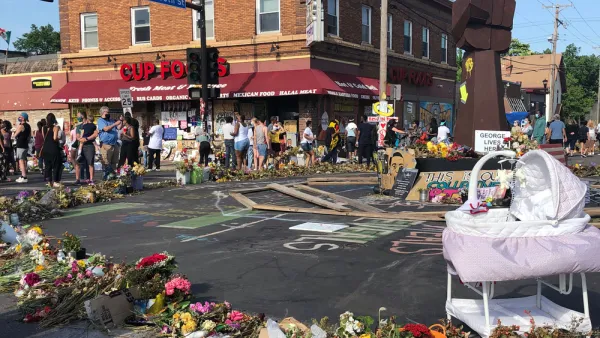
Following George Floyd’s murder in 2020, there was an explosion of anti-racist street art across the country. “When we allow ourselves to release our emotions, oftentimes what is produced out of that is art.”
Feds and Orgs Team Up to Boost Creative Placemaking
Rocco Landesman, Chairman of the NEA, has long make the link between the arts and economic development. He is one of the big hitters behind ArtPlace, a public-private collaboration to foster creative placemaking.
Why Public Art?
Public art plays a role in cities across the world. But what role exactly, and for what purpose? Glass House Conversations explores these questions in this series.

Planetizen Federal Action Tracker
A weekly monitor of how Trump’s orders and actions are impacting planners and planning in America.

California plans to bury El Niño’s downpour
If the state plays its cards right, it may be able to store a billion acre-feet of El Niño’s water in aquifers.

Chicago breaks ground on $3 billion megadevelopment
The new neighborhood, titled Foundry Park, will one day host 3,700 residences.

One of Denver’s busiest corridors to gain BRT
The project will span 18 miles and contain 74 bus rapid transit stations.

275,000 bus trips are at stake on Seattle's ballot
If passed, the Seattle Transit Measure would trigger a 0.3% sales tax and raise an average of $138 million per year to maintain and expand Seattle’s bus services.

Texas may pay Israeli company billions to ease water woes
Texas awarded IDE Technologies the contract for its Harbor Island project, which is slated to become the Western Hemisphere's largest desalination plant.

FREE Course: Walkable City 1: Why Walkability?
After describing his path towards focusing on walkability as the essence of good planning, Jeff Speck marches through his five principal reasons for making more walkable places.
Reinventing Malls: Planning Alchemy—Turning Gray Fields Into Gold
The course focuses on the opportunities and imperatives that shape reinvention of mall sites.

City of Rosemead
Rutgers University, Edward J. Bloustein School of Planning and Public Policy
One Hundred Miles
Hunter College, City University of New York (CUNY)
The Architects Foundation
University of Cincinnati Online
City of Cambridge
Montrose County
The Pocatello Development Authority