With sprawl proceeding largely unchecked in North California, residents who fled the city for more rural areas now find that urbanization has encroached their once sleepy communities.


"Fed up with the encroaching sprawl, Linda Jimenez fled Silicon Valley for Tracy in 1990 in search of more affordable housing and the small-town way of life of her Santa Clara County youth. Eventually, the sprawl caught up.
In 1990, Tracy, a friendly agricultural community separated from the Bay Area by the Altamont Pass, had fewer than 34,000 residents. Today, the mushrooming town, located at the western gateway to the Central Valley, has a population nearing 81,000.
The town sits as a symbol of the quest by working- and middle-class Bay Area residents to find housing they can afford - a pursuit that often draws them further from the traditional job centers in San Francisco, Oakland and San Jose.
The result: A swath of residential and retail development that reaches toward the Sierra foothills, into the agricultural heartland of the Central Valley and south toward Salinas on land once reserved for ranching, farming and recreation.
The migration comes at costs to the environment: loss of natural habitat, increased greenhouse gases and a growing strain on the watershed."
Read the full story: Creeping sprawl overtakes refugees from cities
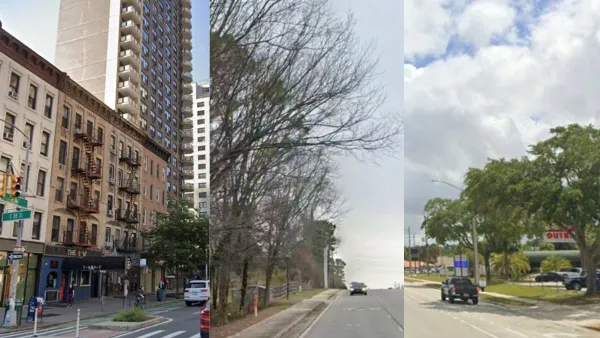
A Transect of sprawl
A development pattern this lifestyle-defining deserves its whole own classification system.

What the fall of earth's largest pre-industrial city can teach us about urban sprawl
Angkor was a low-density metropolis. It lasted six centuries, until it could no longer maintain its infrastructure in a changing climate. Today, it offers planners a sobering warning about the risks of dispersed urban living.

Nearly a third of US housing is in the wildland-urban interface — and at growing risk of wildfire
As suburbs increasingly mingle with undeveloped land, homes face a higher risk from destructive fires.

Planetizen Federal Action Tracker
A weekly monitor of how Trump’s orders and actions are impacting planners and planning in America.

California plans to bury El Niño’s downpour
If the state plays its cards right, it may be able to store a billion acre-feet of El Niño’s water in aquifers.

Desperate measures: Advocates weigh draining Lake Powell to fill Colorado River
Draining the reservoir could reduce evaporation losses by a couple hundred thousand acre-feet.

Voters choose public transit, approve $31 billion in funding
Approved projects include $101,000 for reduced-cost transit in a Michigan town and $14 billion for regional transit in the San Francisco Bay Area.

Study reveals best places in the U.S. for cycling, walking
New research from Streetlight Data examines bicycle and pedestrian miles per capita in the 100 largest U.S. cities by population.

Los Angeles just elected an urban planner as its mayor
Transportation analysts are optimistic that Raman will be more aggressive in addressing transit issues than Bass.

FREE Course: Walkable City 1: Why Walkability?
After describing his path towards focusing on walkability as the essence of good planning, Jeff Speck marches through his five principal reasons for making more walkable places.
Reinventing Malls: Planning Alchemy—Turning Gray Fields Into Gold
The course focuses on the opportunities and imperatives that shape reinvention of mall sites.

City of Rosemead
Rutgers University, Edward J. Bloustein School of Planning and Public Policy
One Hundred Miles
University of Michigan School for Environment and Sustainability (SEAS)
Hunter College, City University of New York (CUNY)
The Architects Foundation
City of Cambridge
Montrose County
The Pocatello Development Authority