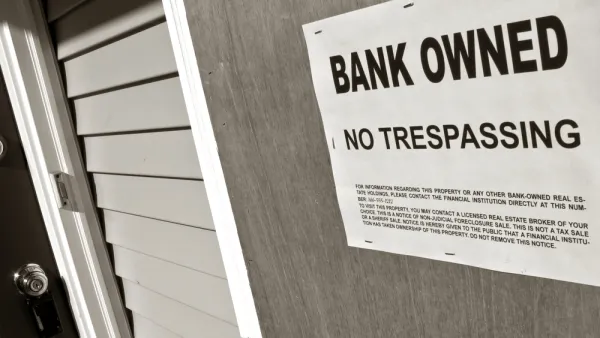
A HUD plan that allows municipalities to buy up foreclosed homes for just $1 is causing controversy in Wayne County, Michigan, where cities and counties are fighting over who is best suited to take over abandoned homes.


"Wayne County's plan to buy more than 700 federally subsidized and foreclosed homes in Detroit and another 500 elsewhere in the county for $1 each has hit a snag."
"Competition."
"The cities where the homes -- mostly abandoned and in disrepair -- are say the county is trying to poach what belongs to the cities."
"Many of the cities had applied or were planning to request the $1 homes when they learned Wayne County was doing the same thing. Many had plans to rehabilitate the homes, sell them to the public or employees or demolish those in the worst shape."
"The homes -- which are among 11,000 foreclosed HUD homes in Michigan and Ohio -- are another sign of the nation's mortgage foreclosure crisis. The $1 program began in 2003 to help communities fight blight. City officials know that one deteriorating vacant home on a block can begin to bring property values down for entire neighborhoods."
"'We know what's best for our community, and we're very interested in partnering with the county on counseling programs to help residents save their homes,' said Riverview Mayor Tim Durand. 'But at the end of the day, we want the houses.'"
Read the full story: Race heats up for $1 homes
Detroit Program Keeps Homeowners Facing Foreclosure Housed
The buyback plan diverts properties from Wayne County's tax foreclosure auction, keeping them in government hands until residents can repay the purchase price.

Analysis: ROAD to Housing Act could take years to implement
HUD is tasked with implementing nine new rules as part of the ROAD to Housing Act — while operating with a significantly reduced staff.

How HUD is dismantling fair housing enforcement
Fair housing law has never been easy to enforce. But HUD's proposal to eliminate the use of disparate impact analysis will remove another crucial tool for doing so.

Planetizen Federal Action Tracker
A weekly monitor of how Trump’s orders and actions are impacting planners and planning in America.

California plans to bury El Niño’s downpour
If the state plays its cards right, it may be able to store a billion acre-feet of El Niño’s water in aquifers.

Desperate measures: Advocates weigh draining Lake Powell to fill Colorado River
Draining the reservoir could reduce evaporation losses by a couple hundred thousand acre-feet.

Los Angeles just elected an urban planner as its mayor
Transportation analysts are optimistic that Raman will be more aggressive in addressing transit issues than Bass.

Mamdani’s pied-à-terre tax survives legal challenge
A panel of judges found that the plaintiffs failed to demonstrate injury as a result of New York City's implementation of the tax.

Eastern Nebraska is running out of electricity
Data centers and electrification are straining eastern Nebraska’s grid, throttling economic development.

FREE Course: Walkable City 1: Why Walkability?
After describing his path towards focusing on walkability as the essence of good planning, Jeff Speck marches through his five principal reasons for making more walkable places.
Reinventing Malls: Planning Alchemy—Turning Gray Fields Into Gold
The course focuses on the opportunities and imperatives that shape reinvention of mall sites.

City of Rosemead
Rutgers University, Edward J. Bloustein School of Planning and Public Policy
One Hundred Miles
University of Michigan School for Environment and Sustainability (SEAS)
Hunter College, City University of New York (CUNY)
The Architects Foundation
City of Cambridge
Montrose County
The Pocatello Development Authority