The upcoming public art project by artist Olafur Eliasson that will place free-standing waterfalls in the waters around New York City highlights the power public art has to generate economic development and revenue for cities.


"For a city, of course, success is often gauged in more tangible terms: Public-art projects can generate an incredible amount of community revenue."
"In 2005, for instance, the European artists Christo and Jeanne-Claude erected more than 7,500 saffron-colored nylon banners across Central Park for two weeks. According to Kate Levin, commissioner at New York's Department of Cultural Affairs, "The Gates" generated approximately $254 million."
"'New York City Waterfalls' is expected to bring New York roughly $55 million over three months – a figure based on tax revenues 'that the city would not get otherwise,' says Ms. Levin. The figure includes tourism-related spending and income from increased use of public transportation near the site."
"Eliasson and the city are also hoping to usher in long-term financial benefits that may be harder to quantify. Consider: The stretch of Manhattan abutting the East River has historically been thought less desirable than the opposite bank of the island. A waterfall constructed on Pier 35, near Rutgers St., will, Eliasson hopes, prod visitors to contemplate the developmental viability of the area."
Read the full story: Turning cities into art galleries

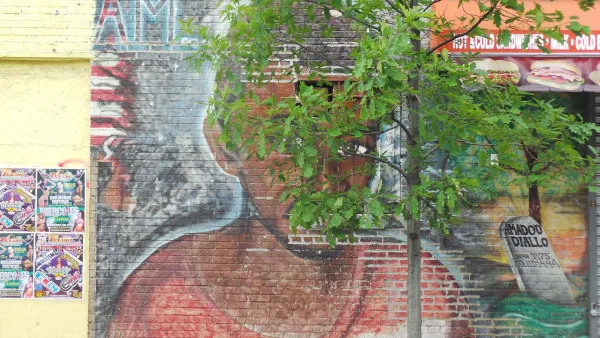
N.Y.C. Artists in Residence Tackle Social Issues
A program in New York brings artists into public agencies to work on collaborative projects that take creative approaches to problem solving.
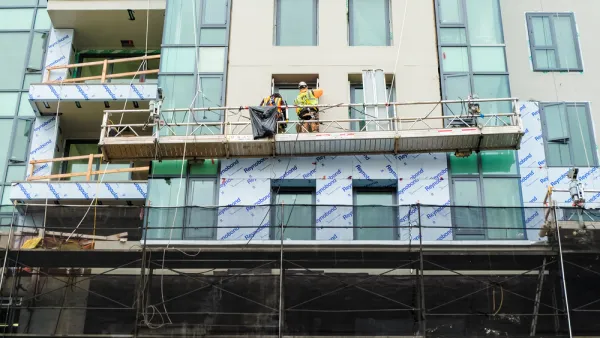
Art May Be Coming to New York City Sidewalk Sheds
Scaffolding and sidewalk sheds being a fixture of life in NYC, the city has decided to let artists do their thing with all that blank canvas.
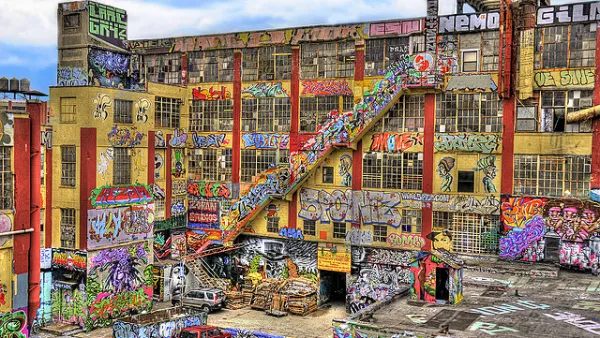
Graffiti Wins Protected Legal Status in New York
A landmark judgement potentially paves the way for graffiti to be protected under the Visual Artists Rights Act.

Planetizen Federal Action Tracker
A weekly monitor of how Trump’s orders and actions are impacting planners and planning in America.

California plans to bury El Niño’s downpour
If the state plays its cards right, it may be able to store a billion acre-feet of El Niño’s water in aquifers.

Chicago breaks ground on $3 billion megadevelopment
The new neighborhood, titled Foundry Park, will one day host 3,700 residences.

One of Denver’s busiest corridors to gain BRT
The project will span 18 miles and contain 74 bus rapid transit stations.

275,000 bus trips are at stake on Seattle's ballot
If passed, the Seattle Transit Measure would trigger a 0.3% sales tax and raise an average of $138 million per year to maintain and expand Seattle’s bus services.

Texas may pay Israeli company billions to ease water woes
Texas awarded IDE Technologies the contract for its Harbor Island project, which is slated to become the Western Hemisphere's largest desalination plant.

FREE Course: Walkable City 1: Why Walkability?
After describing his path towards focusing on walkability as the essence of good planning, Jeff Speck marches through his five principal reasons for making more walkable places.
Reinventing Malls: Planning Alchemy—Turning Gray Fields Into Gold
The course focuses on the opportunities and imperatives that shape reinvention of mall sites.

City of Rosemead
Rutgers University, Edward J. Bloustein School of Planning and Public Policy
One Hundred Miles
Hunter College, City University of New York (CUNY)
The Architects Foundation
University of Cincinnati Online
City of Cambridge
Montrose County
The Pocatello Development Authority