Bureaucratic red tape has slowed the development process for years in Santa Cruz, California. Now proposed changes look to speed up the process, but critics say the changes could open the door to under-controlled development.


"For the first time in decades, planners are looking to address complaints about the red tape that has long stood between property owners and their residential construction endeavors, like home additions and secondary units. But a handful of environmental leaders, buoyed by some elected officials, have greeted proposals to modify the residential code with concern that the changes won't just streamline the planning process but will abet new development."
"'The amendments could create thousands of new housing units in the county, in the hills,' said Aldo Giacchino, chair of the Santa Cruz County chapter of the Sierra Club. That, he fears, would put added pressure on local water supplies, roads and wildlife."
"The threat of legal action by the Sierra Club and concerns raised by local water agencies have put county planners on the defensive during six months of public and private discussions."
"'We're not necessarily retreating,' said Planning Director Tom Burns. 'Our job is to find common ground and move forward.'"
"Burns has maintained that many of the county's residential building ordinances are simply out of date, and contain redundancies and inconsistencies that need fixing."
Read the full story: County wants to cut the red tape, and that has growth foes concerned


Everything you Need to Know from the APA’s 2026 Trend Report for Planners
Plus, a conversation with the APA’s Chief Foresight and Knowledge Officer, Petra Hurtado.

Santa Cruz’s Surf Breaks Under Threat From Climate Change and Coastal Erosion
The Northern California surf haven could lose its iconic waves as projects designed to protect coastal infrastructure alter its coastline.
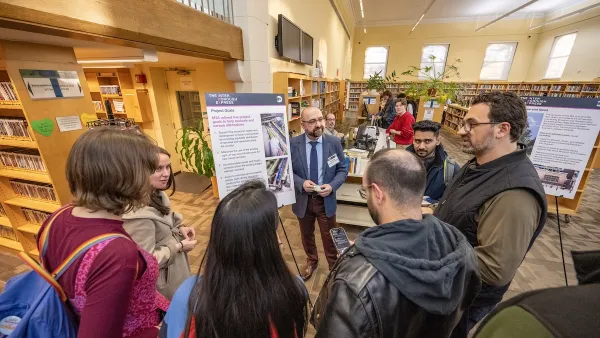
Will Urban Planners Lose Their Jobs to AI?
Let’s see what the data says.

Planetizen Federal Action Tracker
A weekly monitor of how Trump’s orders and actions are impacting planners and planning in America.

‘Going backwards:’ Baltimore mayor, students rally against state's transit funding plan
Maryland's proposed six-year plan provides no funding for Baltimore’s BMORE bus program and reduces its road maintenance funding.

Detroit to transform waterfront with $2.2 billion investment
Developers will convert about 18 acres of unused parking lot space into civic spaces.

85-year-old ranch is Texas’ newest state park
The 650 acre ranch is one of the largest parcels of land along Lake Palestine.

MIT to create AI-powered hub for public transportation companies
Google awarded the project, titled the Public Transit Intelligence Hub, $2.1 million in funding.

A 3D concrete printer may solve Virginia’s housing crisis
The printer is able to build concrete walls much faster than humans, and can do so directly at job sites.

FREE Course: Walkable City 1: Why Walkability?
After describing his path towards focusing on walkability as the essence of good planning, Jeff Speck marches through his five principal reasons for making more walkable places.
Reinventing Malls: Planning Alchemy—Turning Gray Fields Into Gold
The course focuses on the opportunities and imperatives that shape reinvention of mall sites.

City of Thousand Oaks
City of Wisconsin Rapids
Harvard University Graduate School of Design
The Architects Foundation
University of Cincinnati Online
Northern Illinois Transit Authority (NITA)
The Pocatello Development Authority
The Urban Renewal Agency of the City of Pocatello