Beijing's new Norman Foster-designed airport terminal -- 20% bigger than all of Heathrow -- has just opened on the site of 10 former villages.


"In the latest sign of its Olympic frenzy, Beijing has opened the world's biggest airport, an enormous dragon-shaped building 31/4 kilometres in length, built in record speed after the eviction of 10,000 villagers from the site.
The new terminal, almost 20-per-cent bigger than all five terminals of London's Heathrow Airport combined, features an ultra-modern baggage system and a Canadian-designed shuttle train to help people navigate its vast interior.
The first commercial flight, a domestic flight from Shandong province, landed at the new terminal at 8:37 Friday morning. Hundreds of Chinese staff, wearing red sashes as though they were beauty queens, roamed the vast building to help confused visitors.
The $3.75-billion terminal, one of the most prestigious projects of the Olympic construction boom in Beijing, was built by 50,000 workers who toiled on shifts around the clock. It took only four years to finish the terminal, compared with 20 years for the fifth terminal at Heathrow.
Beijing, of course, benefited from the police-state powers of the Chinese government, which demolished 10 villages to make room for the new terminal.
The statistics of the new terminal are stunning. The building has 64 restaurants, 84 retail shops, 175 escalators, 173 elevators, 437 moving sidewalks, nearly 300 check-in counters, and a state-of-the-art baggage-handling system that can move 20,000 pieces of luggage at speeds of up to 10 metres a second on 50 kilometres of conveyor belts. The construction required 1.8 million cubic metres of concrete and 500,000 tonnes of steel.
[China] is planning to have 239 airports by 2020, with 13 of them expected to handle 30 million passengers a year."
Read the full story: Now boarding at world's biggest air terminal
The Best and the Worst Airports to Access
If you want great access to an airport, go overseas—that's the main finding of a study by Golden Gateway Alliance, a Manhattan-based airport advocacy organization. Tied for dead-last in terms of access is Denver and a certain New York airport.
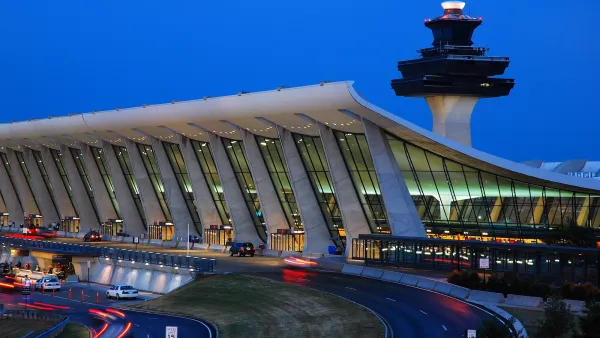
Trump wants to eliminate people movers, add 32,000-car garage to Dulles airport
The proposed renovations would cost roughly $22 billion.

Santa Monica residents argue historic airport is 'critical' for public safety
Some locals are asking the city to reconsider its planned closure of the airport in late 2028.

Planetizen Federal Action Tracker
A weekly monitor of how Trump’s orders and actions are impacting planners and planning in America.

California plans to bury El Niño’s downpour
If the state plays its cards right, it may be able to store a billion acre-feet of El Niño’s water in aquifers.

Desperate measures: Advocates weigh draining Lake Powell to fill Colorado River
Draining the reservoir could reduce evaporation losses by a couple hundred thousand acre-feet.

Mamdani’s pied-à-terre tax survives legal challenge
A panel of judges found that the plaintiffs failed to demonstrate injury as a result of New York City's implementation of the tax.

Eastern Nebraska is running out of electricity
Data centers and electrification are straining eastern Nebraska’s grid, throttling economic development.

Seattle passes record-breaking transit services expansion
Proposition 1 will double the city’s transit tax to add 95,000 more bus trips and preserve 180,000 bus trips annually.

FREE Course: Walkable City 1: Why Walkability?
After describing his path towards focusing on walkability as the essence of good planning, Jeff Speck marches through his five principal reasons for making more walkable places.
Reinventing Malls: Planning Alchemy—Turning Gray Fields Into Gold
The course focuses on the opportunities and imperatives that shape reinvention of mall sites.

City of Rosemead
Rutgers University, Edward J. Bloustein School of Planning and Public Policy
One Hundred Miles
Hunter College, City University of New York (CUNY)
The Architects Foundation
University of Cincinnati Online
City of Cambridge
Montrose County
The Pocatello Development Authority