A Reagan-era "free market approach to conservation" that would deny federal flood insurance to sensitive lands is being undermined through the political process. Congress has granted two exceptions to the law for coastal areas in Georgia and Florida.


"Congress passed two bills (this year) carving out exceptions to a law passed years ago to phase out federal spending that might encourage development in environmentally sensitive and disaster-prone areas.
"One of the bills benefited Jekyll Island, a vacation spot off Georgia's coast that is poised for redevelopment, while the other helped a mostly undeveloped 10-lot subdivision on Florida's Gulf Coast. A handful of similar proposals are pending. After seeing the success of the Georgia and Florida bills this year, property owners in Alabama, Texas and elsewhere are lobbying for their own continued coverage."
"You only have to look at 300 miles of Katrina and Rita wasteland to see that bankrolling federal flood insurance in high-risk areas is just asking the American taxpayer to flush money down the toilet," said Oliver Houck, director of the environmental law program at Tulane University in New Orleans. "If people want to build out there, that's one thing. But to build out there with federal support is insane."
Read the full story: Flood Insurance Getting Political Nod


Planetizen Federal Action Tracker
A weekly monitor of how Trump’s orders and actions are impacting planners and planning in America.

The state-sanctioned urbicide of Austin
People don’t kill cities. Freeways do.
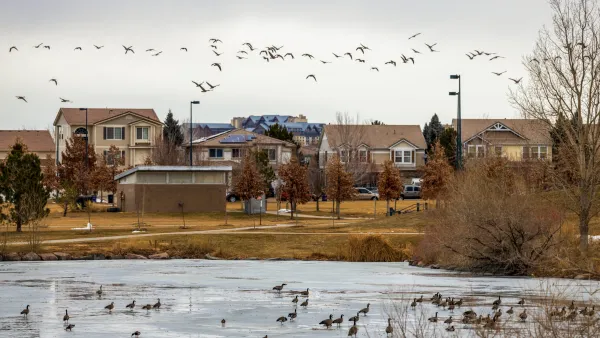
Colorado’s Largest Data Center Could Rise Next to Homes — Without a Public Hearing
The proposed campus would consume 11 times the power of Denver International Airport; as it has across the country, opposition mounts.
Raised interest rates may kill financially vulnerable construction projects
The chief economist at ConstructConnect warns that if construction project owners are negatively impacted by the raised rates, it could result in delayed payments to contractors.

Data centers are consuming nearly 25% of Oregon’s power
The state has 111 data centers, with 32 more either planned or under construction.

A third of Texas cities must update their zoning codes to comply with new housing law
Texas municipalities are now required to allow manufactured housing in at least one residential zoning district.

FREE Course: Walkable City 1: Why Walkability?
After describing his path towards focusing on walkability as the essence of good planning, Jeff Speck marches through his five principal reasons for making more walkable places.
Reinventing Malls: Planning Alchemy—Turning Gray Fields Into Gold
The course focuses on the opportunities and imperatives that shape reinvention of mall sites.

Greater Baltimore Committee
Eagle County Government
Harvard University Graduate School of Design
The Architects Foundation
University of Cincinnati Online
The Pocatello Development Authority
The Urban Renewal Agency of the City of Pocatello
Journal of the American Planning Association