As voters in Arizona overwhelmingly approved a ballot initiative to restrict the government's use of eminent domain, the state's Supreme Court unanimously overturned another court's ruling that the initiative was invalid.


"The Supreme Court on Wednesday upheld a judge's ruling allowing Proposition 207 to go on Tuesday's state general-election ballot but erased the judge's finding that the measure apparently violated a requirement that some propositions include a funding source for implementation costs."
"The Supreme Court issued its unanimous ruling one day after Arizona voters overwhelmingly approved the measure restricting the state's use of eminent domain and ensuring compensation for a property owner whose property values are reduced by government land-use laws."
The issue of legality over the Arizona initiative revolves around a recently passed state law that requires initiatives to identify funding sources for any costs they create. Though the initiative passed, it may still be subject to legal review.
While Arizona and seven other states approved initiatives to limit government's use of eminent domain or to require compensation to owners of acquired property, voters in California, Idaho and Washington rejected these limitations.
Read the full story: Supreme Court erases ruling against property rights measure


Planetizen Federal Action Tracker
A weekly monitor of how Trump’s orders and actions are impacting planners and planning in America.

The state-sanctioned urbicide of Austin
People don’t kill cities. Freeways do.
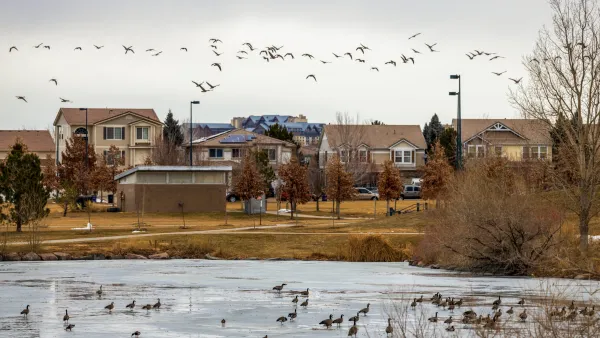
Colorado’s Largest Data Center Could Rise Next to Homes — Without a Public Hearing
The proposed campus would consume 11 times the power of Denver International Airport; as it has across the country, opposition mounts.

Nation's most wind-powered state turns to coal as data centers increase energy demand
For the first time in decades, Iowa has increased its generation of coal power.

NYC cools commuters with city's first rain garden above a bus stop
New York City officials say the plants in the rain garden can absorb 16 gallons of rainwater during heavy storms.

Brightline West’s future may rely on $6 billion federal loan
The company has until Nov. 2 to make a $400 million equity investment into its proposed high-speed rail line.

FREE Course: Walkable City 1: Why Walkability?
After describing his path towards focusing on walkability as the essence of good planning, Jeff Speck marches through his five principal reasons for making more walkable places.
Reinventing Malls: Planning Alchemy—Turning Gray Fields Into Gold
The course focuses on the opportunities and imperatives that shape reinvention of mall sites.

Greater Baltimore Committee
Eagle County Government
Harvard University Graduate School of Design
The Architects Foundation
University of Cincinnati Online
The Pocatello Development Authority
The Urban Renewal Agency of the City of Pocatello
Journal of the American Planning Association