Kenneth S. Deffeyes, author of 'Beyond Oil', calculates that world oil production reached 'Hubbert's Peak' on December 16th, 2005.


"So what are the policy implications? Numerous critics are claiming that the present world economic situation is a house of cards: built on trade deficits, housing price bubbles, and barely-adequate natural gas supplies. Pulling any one card out from the bottom of the pile might collapse the whole structure."
"Since we have passed the peak without initiating major corrective measures, we now have to rely primarily on methods that we have already engineered. Long-term research and development projects, no matter how noble their objectives, have to take a back seat while we deal with the short-term problems. Long-term examples in the proposed 2007 US budget (Feb. 9, 2006 New York Times page A-18) include a 65 percent increase in the programs to produce ethanol from corn, a 25.8 percent increase for developing hydrogen fuel cell cars, and a 78.5 percent increase in spending on solar energy research. The Times reports that solar energy today supplies one percent of US electricity; the hope is to double that to 2 percent by the year 2025. By 2025, we're going to be back in the Stone Age."
Read the full story: Join us as we watch the crisis unfolding


Planetizen Federal Action Tracker
A weekly monitor of how Trump’s orders and actions are impacting planners and planning in America.

‘Going backwards:’ Baltimore mayor, students rally against state's transit funding plan
Maryland's proposed six-year plan provides no funding for Baltimore’s BMORE bus program and reduces its road maintenance funding.
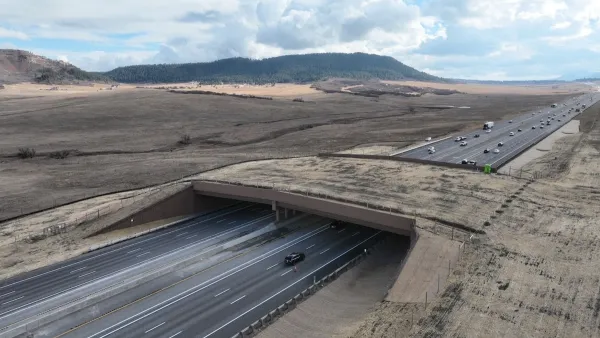
Record-breaking wildlife overpass in Colorado brings 91% reduction in animal collisions
Prior to the overpass, vehicles were hitting one deer per day on Colorado’s Interstate 25.

Mamdani sent nearly 6,000 pied-à-terre tax warnings to homes that didn’t qualify
A judge has ordered the administration to cancel thousands of pied-à-terre tax notices after it sent 35% of them erroneously.

Detroit to transform waterfront with $2.2 billion investment
Developers will convert about 18 acres of unused parking lot space into civic spaces.

‘Going backwards:’ Baltimore mayor, students rally against state's transit funding plan
Maryland's proposed six-year plan provides no funding for Baltimore’s BMORE bus program and reduces its road maintenance funding.

FREE Course: Walkable City 1: Why Walkability?
After describing his path towards focusing on walkability as the essence of good planning, Jeff Speck marches through his five principal reasons for making more walkable places.
Reinventing Malls: Planning Alchemy—Turning Gray Fields Into Gold
The course focuses on the opportunities and imperatives that shape reinvention of mall sites.

City of Thousand Oaks
City of Wisconsin Rapids
Harvard University Graduate School of Design
The Architects Foundation
University of Cincinnati Online
Northern Illinois Transit Authority (NITA)
The Pocatello Development Authority
The Urban Renewal Agency of the City of Pocatello