The downtown streetcar saw a surge in ridership after it eliminated fares in January.


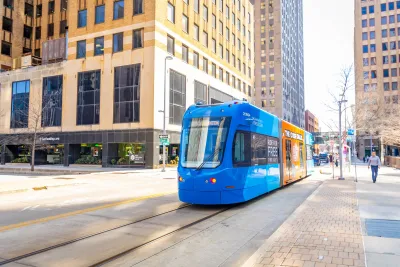
The Central Oklahoma Transportation and Parking Authority announced plans to keep the Downtown OKC streetcar fare-free after a pilot program that began in January led to a rise in ridership of up to 74%, reports Brett Fieldcamp in Oklahoma City Free Press.
"As our city continues to invest in projects and host major events coming to downtown Oklahoma City, the streetcar can improve downtown circulation, help ease traffic congestion and boost economic activity for downtown businesses," said Jesse Rush, Director of EMBARK, the city's transit authority.
In his State of the City address, Mayor David Holt signaled strong support for the project and other initiatives to boost transit, and acknowledged that fare revenue is often a small part of a transit system's operating budget. "According to Holt’s post Friday, the measure of success for a public service shouldn’t be a dollar amount or a financial return on investment, but the enthusiasm with which the public engages with the service." Holt added, "if the community is using it, it has value."
Read the full story: OKC Streetcar to remain permanently free after pilot program success


Oklahoma City Streetcar Goes Fare-Free in January
The system saw its highest ridership ever in the last fiscal year.
Fisticuffs: The argument FOR fare-free transit
When the barrier to entry drops to zero, magic can happen.

Fisticuffs: The argument AGAINST fare-free transit
If a terrible bus becomes free, will it truly free you?

Planetizen Federal Action Tracker
A weekly monitor of how Trump’s orders and actions are impacting planners and planning in America.

Amtrak, CN end decades-long dispute with eight-year agreement
The new operating agreement establishes an updated framework for the companies to work together, including processes to resolve disputes.

Northwest rail fans eager for Sept. 30 debut of Amtrak’s Airo fleet
Get ready for that new train smell and more seats. But they won’t go faster or run more frequently on the Cascades route in Washington and Oregon.

St. Louis Metro to test if single-car trains can reduce operating costs, maintain rider satisfaction
The pilot program will run from October to spring 2027, and begin with one single-car train operating on Metrolink’s Red and Blue lines.

Pennsylvania is building data centers in abandoned mines
Housing data centers in mines provides an alternative to destroying local forests and may spare residents from data centers’ noise and air pollution.

If Corpus Christi can’t revive desalination plant project, it may owe Texas $235 million
Earlier this month, city officials declined to pursue developing the plant for the second time in a year.

FREE Course: Walkable City 1: Why Walkability?
After describing his path towards focusing on walkability as the essence of good planning, Jeff Speck marches through his five principal reasons for making more walkable places.
Reinventing Malls: Planning Alchemy—Turning Gray Fields Into Gold
The course focuses on the opportunities and imperatives that shape reinvention of mall sites.

City of Thousand Oaks
City of Wisconsin Rapids
Harvard University Graduate School of Design
The Architects Foundation
University of Cincinnati Online
The Pocatello Development Authority
The Urban Renewal Agency of the City of Pocatello