Nationwide data shows that roundabouts reduce injuries in crashes by 72%.


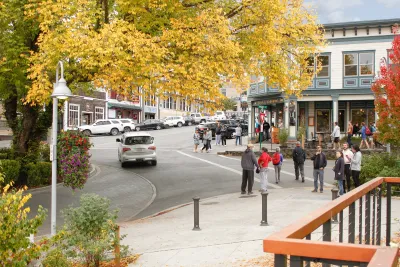
Washington state has built 607 roundabouts across the state, the fourth-most in any U.S. state, reports Mike Lindblom in The Seattle Times.
"Washington’s roadway overhaul unfolded quietly, at a few crossings where highway engineers hoped they could reduce crippling crashes, if they made drivers outside Bellingham, Lake Stevens or Marysville travel in circles," Lindblom explains. "A study of 2009-16 data, by the insurance institute, found that in 540 multilane Washington state roundabout crashes (four per year per site), only 18, or 3%, resulted in injuries. Total crashes declined 9% per year on average, and injury crashes also lessened, indicating that drivers got safer with experience."
According to a broader national study by the Insurance Institute for Highway Safety, roundabouts lead to 72% fewer injuries and 35% fewer crashes. "Because drivers bend through at 15 to 20 mph, rather than zip straight through an intersection at 30 to 50 mph, severe injuries decline."
The more than 600 large roundabouts are in addition to over 1,000 smaller neighborhood traffic circles that have existed in Seattle for fifty years. Lindblom explains that roundabouts aren't effective everywhere: for example, they don't work well where traffic mostly flows in one direction, or in areas with a lot of pedestrian traffic.
Read the full story: Why more WA drivers are going in circles

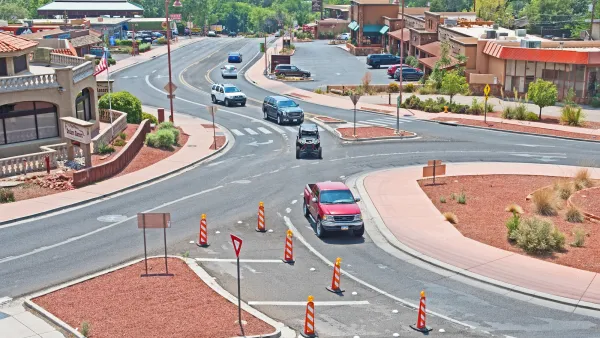
Study: Roundabouts are Primarily in Wealthier Neighborhoods
A North Carolina study sheds light on inequities in road safety interventions.

How I Learned to Stop Worrying and Love the Roundabout
What drives the U.S. backlash to roundabouts — objectively safer and more efficient than stop-and-go intersections?
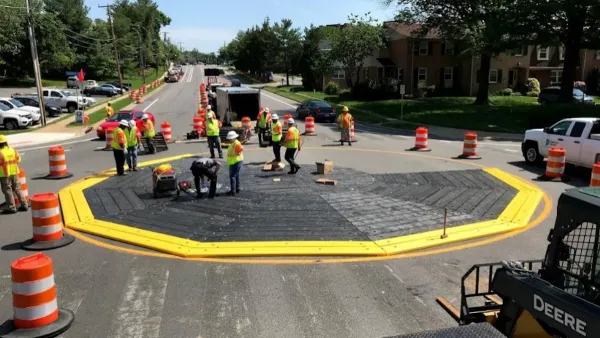
‘Modular Roundabouts’ Offer Quick-Build Traffic Safety Solution
The prefabricated roundabouts can be installed more quickly and at a much lower cost than traditional concrete traffic circles.

Planetizen Federal Action Tracker
A weekly monitor of how Trump’s orders and actions are impacting planners and planning in America.

Chicago breaks ground on $3 billion megadevelopment
The new neighborhood, titled Foundry Park, will one day host 3,700 residences.

Denver is solving homelessness. Why aren't the rest of us?
Since 2023, Denver's street homeless population has decreased by 64%, proving that effective tools exist to support those in need of housing.

LA accused of breaching $1.4 billion sidewalk repair settlement
The city faces a backlog of nearly 5,000 street repair requests.

MTA kicks off six-year, $1 billion transit upgrade project
The authority is replacing the roughly 90-year-old train signals on the A and C line with modern technology.

Developers may expand largest gas pipeline network in Northwest
Pipeline giant Williams has proposed new expansions for its Northwest Pipeline from the Colorado Rockies through Idaho, Oregon and Washington.

FREE Course: Walkable City 1: Why Walkability?
After describing his path towards focusing on walkability as the essence of good planning, Jeff Speck marches through his five principal reasons for making more walkable places.
Reinventing Malls: Planning Alchemy—Turning Gray Fields Into Gold
The course focuses on the opportunities and imperatives that shape reinvention of mall sites.

City of Rosemead
Rutgers University, Edward J. Bloustein School of Planning and Public Policy
One Hundred Miles
The Architects Foundation
University of Cincinnati Online
Montrose County
Northern Illinois Transit Authority (NITA)
The Pocatello Development Authority