Over 13,000 comments were submitted in the federal Request for Information on surface transportation reauthorization. We analyzed all of them.


This piece is part of a series analyzing the 2026 surface transportation reauthorization process. Read more here.
The one-year countdown has begun until the current surface transportation authorization expires on September 30, 2026. As the transportation industry works to determine priorities for reauthorization over the next year, one thing is abundantly clear: a successful reauthorization bill must prioritize all users of a transportation system. To prioritize more than just highway spending, we should listen to what the public wants.
But first: why is reauthorization important?
Surface transportation reauthorization is an opportunity to solidify the agenda-setting for surface transportation priorities and goals. Reauthorization provides a multi-year funding source that gives states the certainty to plan and execute long-term surface transportation projects. Reauthorization defines grant programs, allocates funding to them, determines how that funding is disbursed, and outlines their requirements. Reauthorization also often includes requirements for the United States Department of Transportation (USDOT) to update its regulations, as instructed by Congress. There have been seven reauthorizations since 1991, with the most recent being the Infrastructure Investment and Jobs Act, also known as the Bipartisan Infrastructure Law (BIL).
Reauthorization also provides an opportunity to rethink the priorities and functions of our surface transportation system. Understanding the public’s advocacy allows evidence-based decision-making that could be included as key priorities.
Putting the public’s evidence-based reauthorization priorities front and center
In July of last year, USDOT issued the "Advancing a Surface Transportation Proposal That Focuses on America's Most Fundamental Infrastructure Needs" Request for Information (RFI) to gather public input on reauthorization priorities. The RFI provides a look into the public’s priorities for infrastructure investment and gives an idea of the importance of reauthorization priorities to highlight.
Through a fruitful partnership with other Planetizen contributors, we analyzed the comments posted to the Federal Register, utilizing artificial intelligence to define key themes and comments that capture the public’s requests in a bill. Stay tuned for a later article describing our methodology. In the meantime, the top five themes surfaced through the RFI are as follows:
Theme 1: Fund the Wildlife Crossings Pilot Program
Key Takeaway: Safety means different things to different people, but it is all a part of a safer system.
The Wildlife Crossings Pilot Program seeks to reduce wildlife-vehicle collisions while improving habitat connectivity for species. While overlooked in safety conversations, research shows that wildlife crossing programs reduce crashes and save lives.
Support for this program represented the single largest volume of comments, though it should be noted that this was driven by the National Wildlife Federation Action Fund's mass submission of 8,600+ comments. Nonetheless, commenters — who also included the Idaho Wildlife Federation, Wyoming Wildlife Federation, Center for Climate and Energy Solutions, and others — made the case that:
- Evidence shows a 80-97% reduction in wildlife-vehicle collisions from properly designed crossings.
- The program currently receives applications far exceeding available funding capacity.
- The program has bipartisan public support (83% Republicans, 88% Democrats, according to a 2023 Harris Poll).
- Annual collision costs of $8-10 billion make crossings cost-effective investments that "often pay for themselves within a decade."
Theme 2: Respond to the roadway safety crisis, which took over 40,000 lives in 2022
Key takeaway: Safety needs to be an explicit set-aside that maintains local government support.
It is well documented that the United States has a roadway safety problem, and addressing it requires data-driven solutions that incorporate Proven Safety Countermeasures that reduce serious injury and fatal crashes. A part of the Safe System Approach argues that “redundancy is crucial,” which demonstrates that there is not one catch-all solution to reduce crashes, and instead there needs to be multiple investments at every level of our transportation system to create safety. This also means preserving programs like Safe Streets and Roads for All (SS4A) and investing in safety countermeasures that support all roadway users, and not just people driving.
Commenters showed strong support for the following programs:
- Safe Streets and Roads for All (SS4A), which jurisdictions identified as "key to funding effective, context-appropriate strategies"
- Highway Safety Improvement Program (HSIP)
- Transportation Alternatives Program
Commented also noted that the road safety crisis claims almost 40,000 lives annually, and submitted requests for the Federal Highway Administration (FHWA) to incentivize implementation of proven safety countermeasures, which are data-driven design solutions that make roadways safer for all road users. Additionally, industry and trade associations also emphasized safety as defined by the need to protect construction workers and roadside repair technicians.
Theme 3: Fund public transportation for everyone
Key takeaway: Transit needs investment across the board for all communities.
The Trump administration has made it clear that they do not want to prioritize transit funding. Despite providing recent funding to make transit more "family-friendly" and "affordable," investment in transit is still lacking, and transit services are at a crucial tipping point. To the public, funding transit means closing operating funding gaps, providing adequate funding to work through the State of Good Repair (SOGR) backlog, and investing more in rural transit. In the RFI, SOGR was transit agencies' central concern, citing the $140B+ FTA funding gap.
Multiple large agencies — including BART, SCRRA, IndyGo and others — submitted comments advocating for Capital Investment Grants, and there were also calls to raise the federal share of rural transit operating funding from 50% to 80%.
One of the most unanimously raised concerns across transit agencies of all sizes was about operating cost restrictions. Two comments submitted sum up the issue:
- "Transit agencies can purchase new buses or build new rail lines with federal funds, but often lack sufficient funding to cover the costs of fuel and wages for operators."
- "A new bus serves no purpose without the money to operate it."
Theme 4: Speed up the NEPA process and tackle its reform
Key takeaway: Key hurdles that slow down the project development process should be reconsidered.
Across commenters, from State Departments of Transportation to local agencies, there is a broad consensus to streamline the environmental review processes and speed up reviews for the National Environmental Policy Act (NEPA). NEPA reforms are already a priority of the Trump administration, but it is now up to lawmakers to balance NEPA reform with ensuring any process streamlining still results in the ultimate goal of the policy: protecting the environment.
State Departments of Transportation are strong supporters of NEPA streamlining reform in the RFI, arguing that:
- Current timelines are excessive
- Categorical exclusion thresholds should increase substantially (to $20-25M)
- State assumption should be faster and simpler
While environmental groups did not oppose efficiency, they expressed concern that streamlining could eliminate meaningful review and emphasized maintaining substantive protections. There were recommendations for AI-powered NEPA platforms, GIS-based early impact assessment and blockchain for document transparency to balance the two interests.
States also showed strong support for One Federal Decision and sought expanded authority under 23 U.S.C. § 326 and § 327 for NEPA assignment with faster federal approval timelines.
Theme 5: Invest in Active Transportation and infrastructure for people who walk and bike
Key takeaway: Despite the Trump administration signaling the contrary, the public still wants better, safer infrastructure for people who walk and bike.
The Trump administration argues that infrastructure for pedestrians and bicyclists is "hostile to cars." They have attempted to remove bike lanes, change crosswalks, and have made it clear that a reauthorization bill will deprioritize active transportation in pursuit of highway funding. The public makes it clear, though: people want bike lanes, protected infrastructure, and pedestrian safety improvements, and increased funding opportunities and grant program allocations that support that priority.
That said, this topic was the most highly contested in the RFI arena. While a substantial number of comments advocated for bike lanes, protected infrastructure and pedestrian safety improvements, a smaller but vocal segment supported US Secretary of Transportation Sean Duffy's position that bike lanes should not come "at the expense of vehicles." This polarization was particularly prevalent amongst individual citizen commenters. Urban residents and safety advocates argued for increased funding for programs that provide Active Transportation funding, like Transportation Alternatives and the Active Transportation Infrastructure Investment Program.
Who wanted what?
Here’s an interesting breakdown of which kinds of organizations prioritized what in their RFI comments:
- Environmental and Conservation Organizations focused on wildlife crossings, habitat connectivity, ecosystem protection, and climate resilience, prioritizing programs including the Wildlife Crossings Pilot Program (permanent authorization with increased funding), PROTECT and the Culvert AOP Program.
- State Departments of Transportation focused on regulatory flexibility, formula funding maximization, NEPA streamlining and reduced federal oversight. Their dominant policy position was support for returning to pre-IIJA funding structures with fewer categorical programs and more state discretion. They specifically requested expanded categorical exclusions, streamlined Section 4(f) for historic bridges and the elimination of performance target penalties. A few notable submitters in this category included the Virginia DOT, Florida DOT, Ohio DOT and joint five-state coalition (Idaho, Montana, North Dakota, South Dakota, Wyoming).
- Transit Agencies and Authorities primarily focused on operating funds eligibility, SOGR investment, CIG program preservation and regulatory relief. They were united by concerns about the current prohibition on using federal formula funds for operations severely constraining service delivery, and also made request for software-as-a-service eligibility for capital funds. Some notable submitters here included BART, Virginia Railway Express, San Joaquin RTD, Community Transit and Access Services.
- Local Governments and Metropolitan Planning Organizations focused heavily on direct federal funding access, local control over project selection and simplified compliance, arguing that local governments own the majority of transportation infrastructure but lack proportionate funding access. They specifically requested funds for SS4A, RAISE, Transportation Alternatives and Reconnecting Communities. Some submitters included the City of San José, City of Richmond, Davis County (UT), San Joaquin COG, and various MPOs.
- Industry and Trade Associations unsurprisingly focused on workforce development as well as regulatory certainty, user-fee funding mechanisms and private sector partnerships. They strongly supported Highway Trust Fund solvency through user-based revenue models and tolling flexibility, as well as an emphasis on work zone protections, truck parking expansion, EV infrastructure deployment. A few notable submitters included IBTTA, ACEC, Railway Supply Institute, Alliance for Automotive Innovation and the U.S. Chamber of Commerce.
- Individual Citizens, as mentioned, were polarized with strong support for bike/pedestrian infrastructure from urban residents and some opposition from those prioritizing vehicle throughput. They showed near-universal support for wildlife crossings, showing broad public consensus on this issue, and submitted personal stories of crashes, family member deaths, and near-misses to call for safer road design.
- Tribal Nations focused heavily on Tribal Transportation Program (TTP) funding increases, formula reform and direct access to programs. They specifically requested raising TTP’s Safety Fund from $10M to $30M annually and reforming the Tribal Technical Assistance Program. There was a specific request for digital sovereignty, with the Habematolel Pomo of Upper Lake requesting recognition of tribal authority over digital infrastructure.
It’s time to write a reauthorization bill that the public wants
The data is clear about what the public thinks the priority for reauthorization should be, but the Trump administration’s priorities and what Congress is signaling run counter to what the public wants. It’s time for advocates and practitioners to argue for evidence-based decision-making and programs within reauthorization. Otherwise, we risk undoing the progress we've made towards creating better transportation systems for all roadway users.
—
A huge thank you to Tom Sanchez and Yoonjeong Kang for their artificial intelligence-aided analysis of the comments submitted to the RFI, which informed this article. Stay tuned to learn more from their work in the coming weeks as we continue to delve into the transportation reauthorization process.

Follow Planetizen’s analysis of surface transportation reauthorization
Follow along as we explore the upcoming surface transportation reauthorization bill and its potential impacts on US transportation infrastructure in the coming years.
Pennsylvania Adopts State Transportation Plan
The plan addresses roads, transit, and other transportation infrastructure over the next 12 years.
Rail advocates: BUILD America 250 Act could slash railway funding by 80%
Leaving rail funding up to annual appropriations threatens to drastically limit its reliability and effectiveness.

Planetizen Federal Action Tracker
A weekly monitor of how Trump’s orders and actions are impacting planners and planning in America.

Data reveals that NYC’s bet on congestion pricing has paid off
After almost two years of the program, reports show positive impacts on traffic and air quality and no disruptions to parking.
Denver is solving homelessness. Why aren't the rest of us?
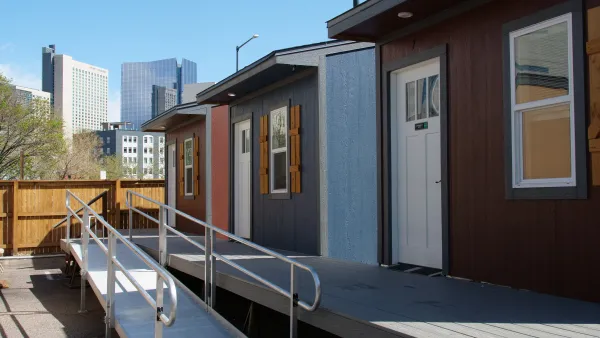
Since 2023, Denver's street homeless population has decreased by 64%, proving that effective tools exist to support those in need of housing.

Chicago's streets are littered with dead birds. Will the city protect them?
Chicago sits in the route of migratory birds traveling south. Its abundance of glass buildings and bright lights make it particularly disorienting for the animals.

CA city to shut down airport, transform it into utopian park
The western side of the 200-acre park will feature a dog park, nature education center and arboretum.

NYC to vote on supporting outdoor dining, streamlining bus and bike lane creation
The city has five proposed amendments to its municipal constitution on the ballot this November.

FREE Course: Walkable City 1: Why Walkability?
After describing his path towards focusing on walkability as the essence of good planning, Jeff Speck marches through his five principal reasons for making more walkable places.
Reinventing Malls: Planning Alchemy—Turning Gray Fields Into Gold
The course focuses on the opportunities and imperatives that shape reinvention of mall sites.

City of Rosemead
Rutgers University, Edward J. Bloustein School of Planning and Public Policy
One Hundred Miles
The Architects Foundation
University of Cincinnati Online
Montrose County
Northern Illinois Transit Authority (NITA)
The Pocatello Development Authority

