Every driver is also a pedestrian at the start and end of their trip, but transportation systems often don’t acknowledge that.


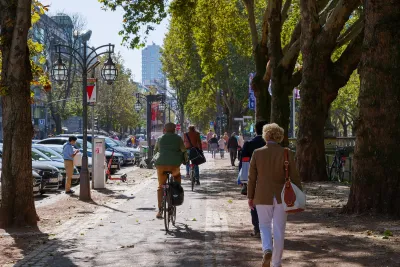
In a piece in Fast Company, Andy Boenau argues that designing roads for the “average driver,” much like designing aircraft cockpits for the average pilot, is a disservice to everyone.
Boenau:
Designing for the average driver creates a phantom user—a person who materializes inside their vehicle, drives, and dematerializes upon arrival. This ghost never walks across a street, never uses a bicycle or scooter, never uses a downtown circulator bus, and only makes long trips. The ghost is capable of seeing and hearing everything, is always alert and sober, doesn’t experience chronic pain, doesn’t need a cane or wheelchair, isn’t young, and isn’t old. And of course, if the imaginary average driver has to wait a few seconds behind other people, the economy will collapse.
But every driver is at some point of their journey a pedestrian, too. “By optimizing transportation systems for the average motorist, we’re making significant portions of every trip uncomfortable or dangerous for everyone.” By designing for the statistical middle, we’re not designing well for anyone.
Complete Streets, on the other hand, acknowledges that people switch modes and accommodates the full range of road users with infrastructure like bike lanes, accessible curb cuts, and transit lanes. But while some U.S. communities have adopted a Complete Streets approach, progress remains “frustratingly slow.”
FULL STORY: What is Complete Streets design, and why should we all be using it?

Mamdani to Revive Multiple Complete Streets Projects Killed by Adams
NYCDOT will restore several proposed bike and bus lanes.
California Governor Signs Complete Streets Bill Into Law
The state’s transportation agency will be required to prioritize multimodal transportation infrastructure and improve transparency.
Boston budget proposal kills funding for dozens of road safety projects
Mayor Wu's FY2027 budget eliminates or reduces funding for multiple unbuilt street safety projects.

Planetizen Federal Action Tracker
A weekly monitor of how Trump’s orders and actions are impacting planners and planning in America.

The state-sanctioned urbicide of Austin
People don’t kill cities. Freeways do.

US to reduce Colorado River water deliveries to Mexico
A new Colorado Treaty amendment reduces Mexico’s Colorado River water allocation by 250,000 acre feet.

Baltimore to break ground on $50 million Transit Priority Project
The project will bring faster bus trips, safer streets and better bike connections to Baltimore.

Airbnb launches $250 million 'last-dollar financing' housing accelerator, makes first investment in Austin
The company will put $6.4 million towards affordable housing development in Texas’ capital.

Guerilla urbanists are building DIY bus stop benches in Chicago
A before-and-after of one of the bus stops with a new bench. The new benches are not officially sanctioned or permitted, but the residents who placed them hope they will be the start of a network of DIY benches across the city.

FREE Course: Walkable City 1: Why Walkability?
After describing his path towards focusing on walkability as the essence of good planning, Jeff Speck marches through his five principal reasons for making more walkable places.
Reinventing Malls: Planning Alchemy—Turning Gray Fields Into Gold
The course focuses on the opportunities and imperatives that shape reinvention of mall sites.

Eagle County Government
Harvard University Graduate School of Design
Nashville Planning Department
The Architects Foundation
University of Cincinnati Online
The Pocatello Development Authority
The Urban Renewal Agency of the City of Pocatello
Journal of the American Planning Association