Since the agency switched to in-house security, fare enforcement citations have plummeted.


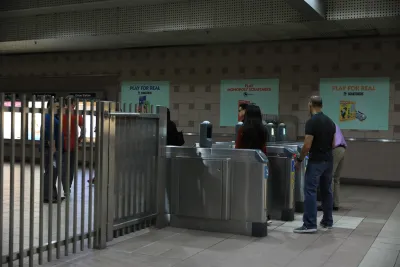
An analysis by Alex Davis, Nimesh Rajakumar, and Erica Solis reveals that Los Angeles Metro typically issues less than 10 citations for fare evasion per day systemwide, effectively rendering the system free to use for those who choose not to pay fares.
According to a piece by the authors in the Los Angeles Daily News, roughly 46 percent of Metro riders do not pay their fares. “That’s 12 million unpaid boardings each month. And because (according to Metro) over 90% of those who commit crimes on the system enter without paying, it’s no surprise that onboard issues related to crime and antisocial behavior have persisted ever since the pandemic.”
The authors note that fare enforcement levels “collapsed” after 2017, when the agency shifted those duties from LA Sheriffs to in-house security. Since then, concerns about safety and cleanliness have also risen, a change the authors seem to link to growing levels of fare evasion.
It’s time to get real about fare enforcement. Our proposal is to retask the TSOs to conduct onboard proof-of-payment validations of TAP cards across the system. At a modest rate of 20 cards an hour per TSO, we believe Metro could check over 20,000 riders a day with existing staff.
The authors believe their proposed strategy would raise fare compliance levels without impacting low-income riders who have access to Metro’s LIFE free fare program. “For the last five years, LA Metro has inadvertently become America’s largest free transit experiment. According to the majority of riders, it hasn’t gone well.”
FULL STORY: How LA Metro quietly stopped enforcing fares

LA Metro Fare Enforcement Faces Backlash
The agency hopes cracking down on fare evasion will improve safety on the system, but riders aren’t so sure.
Seattle to Reinstate Bus Fare Enforcement
After a COVID-era move to eliminate fare inspections on city buses, King County Metro is reinstating checks for fare evasion.

Sound Transit Adds ‘Fare Ambassadors’ to Enforce Payment
Riders found without proof of payment will have options to pay rather than receive a citation.

Planetizen Federal Action Tracker
A weekly monitor of how Trump’s orders and actions are impacting planners and planning in America.

The state-sanctioned urbicide of Austin
People don’t kill cities. Freeways do.

US to reduce Colorado River water deliveries to Mexico
A new Colorado Treaty amendment reduces Mexico’s Colorado River water allocation by 250,000 acre feet.

5 New England states march closer to 800 megawatt wind energy project
Securing federal approval for the project may be complicated under the Trump administration, which has historically been hostile towards domestic wind power.

Baltimore to break ground on $50 million Transit Priority Project
The project will bring faster bus trips, safer streets and better bike connections to Baltimore.

Airbnb launches $250 million 'last-dollar financing' housing accelerator, makes first investment in Austin
The company will put $6.4 million towards affordable housing development in Texas’ capital.

FREE Course: Walkable City 1: Why Walkability?
After describing his path towards focusing on walkability as the essence of good planning, Jeff Speck marches through his five principal reasons for making more walkable places.
Reinventing Malls: Planning Alchemy—Turning Gray Fields Into Gold
The course focuses on the opportunities and imperatives that shape reinvention of mall sites.

Eagle County Government
Harvard University Graduate School of Design
Nashville Planning Department
The Architects Foundation
University of Cincinnati Online
The Pocatello Development Authority
The Urban Renewal Agency of the City of Pocatello
Journal of the American Planning Association