Thanks largely to one alderperson’s efforts, the city has made mini-roundabouts a key piece of its road safety strategy.


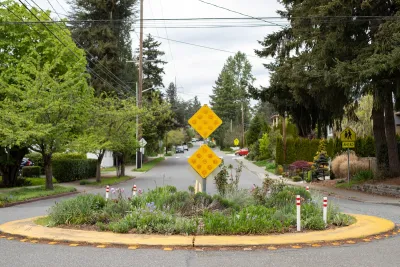
Although not all residents may understand their role, Chicago’s neighborhood roundabouts are an effective traffic calming measure.
Championed by Alderperson Mary Ann Smith in the 1990s, roundabouts are an effective way to slow traffic on neighborhood streets without forcing cars to come to a complete stop, explains Shawn Allee in an article for WBEZ Chicago.
“Most of Chicago’s traffic circles have been built by alderpeople who requested one via the aldermanic menu program, a discretionary budget reserved for infrastructure projects such as alley resurfacing, speed humps and various traffic calming devices.” According to Ald. Andre Vasquez, this process leads to a piecemeal approach that could leave out streets with the highest needs, and wants to see City Hall take a more active role in the installation of traffic circles.
Read the full story: Why Chicago goes round and round with traffic circles
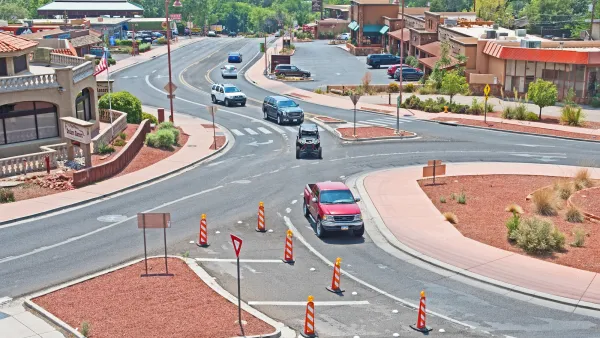
Study: Roundabouts are Primarily in Wealthier Neighborhoods
A North Carolina study sheds light on inequities in road safety interventions.
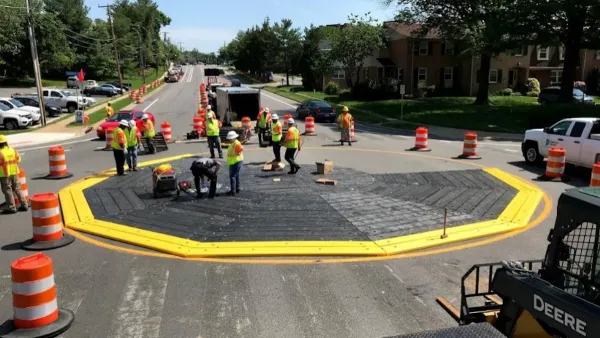
‘Modular Roundabouts’ Offer Quick-Build Traffic Safety Solution
The prefabricated roundabouts can be installed more quickly and at a much lower cost than traditional concrete traffic circles.
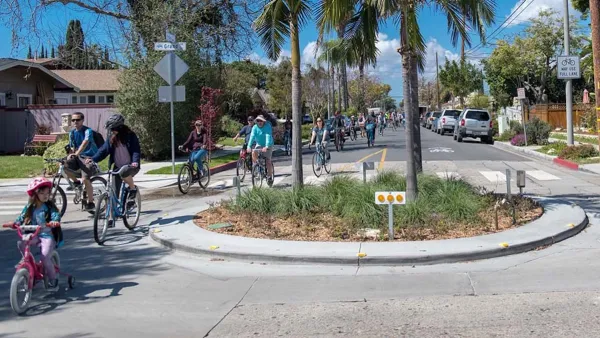
Long Beach Has Installed Nearly 100 Traffic Circles
They range from large traffic circles that reduce congestion to small neighborhood roundabouts designed to slow local traffic.

Planetizen Federal Action Tracker
A weekly monitor of how Trump’s orders and actions are impacting planners and planning in America.

California plans to bury El Niño’s downpour
If the state plays its cards right, it may be able to store a billion acre-feet of El Niño’s water in aquifers.

Desperate measures: Advocates weigh draining Lake Powell to fill Colorado River
Draining the reservoir could reduce evaporation losses by a couple hundred thousand acre-feet.

US buildings threatened, destroyed by fires set to triple by 2060
Researchers found a high fire risk for socioeconomically vulnerable neighborhoods in the American West.

LA residents may be allowed to paint their own crosswalks
Councilwoman Katy Yaroslavsky put out a motion instructing the Los Angeles Department of Public Transportation to study the feasibility of allowing volunteers to paint crosswalks.

Dallas moves to overhaul its zoning code
The city's zoning reform will allow more multi-family and mixed-use developments.

FREE Course: Walkable City 1: Why Walkability?
After describing his path towards focusing on walkability as the essence of good planning, Jeff Speck marches through his five principal reasons for making more walkable places.
Reinventing Malls: Planning Alchemy—Turning Gray Fields Into Gold
The course focuses on the opportunities and imperatives that shape reinvention of mall sites.

City of Rosemead
Rutgers University, Edward J. Bloustein School of Planning and Public Policy
One Hundred Miles
Hunter College, City University of New York (CUNY)
The Architects Foundation
University of Cincinnati Online
City of Cambridge
Montrose County
The Pocatello Development Authority