Despite evidence that colorful crosswalks actually improve intersection safety — and the lack of almost any crosswalks at all on the nation’s most dangerous arterial roads — U.S. Transportation Secretary Duffy is calling on states to remove them.


In a purported effort to reduce traffic fatalities, U.S. Transportation Secretary Sean Duffy has directed states to remove “rainbow crosswalks” — “even though a 2022 Bloomberg study showed that multi-colored "asphalt art" actually cuts crashes between motorists and vulnerable road users by 50 percent on average.”
Writing in Streetsblog USA, Kea Wilson notes that Duffy’s letter to state governors sought to address traffic deaths on arterial roads — not the smaller neighborhood roads usually home to multicolored crosswalks. “Moreover, advocates pointed out that many American arterials are sorely lacking in any crosswalks at all, nevermind ones that double as horizontal murals.”
Although some critics of non-traditional crosswalks say they could decrease safety, evidence shows that brighter, more colorful crosswalk treatments can actually improve safety. “Many advocates have actually pushed to add rainbow crosswalks to the list of recommended markings in the MUTCD because of their potential to save lives, along with other revisions like prompting traffic engineers to install more frequent and better-protected crosswalks on neighborhood arterials.”
FULL STORY: Removing ‘Rainbow Crosswalks’ Won’t Make America’s Arterials Safer

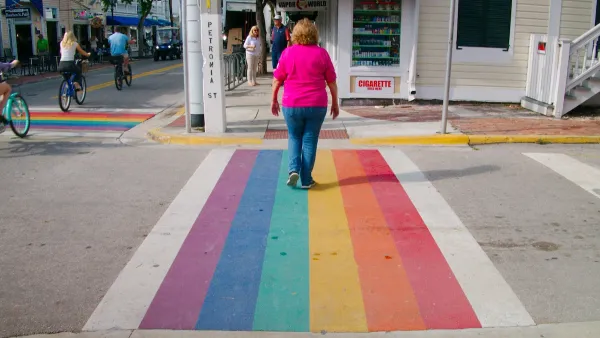
The Florida Cities Risking Everything to Save Rainbow Sidewalks
Gov. DeSantis has threatened to withhold state transportation funding and remove local leaders who don’t comply with an order to remove painted crosswalks.
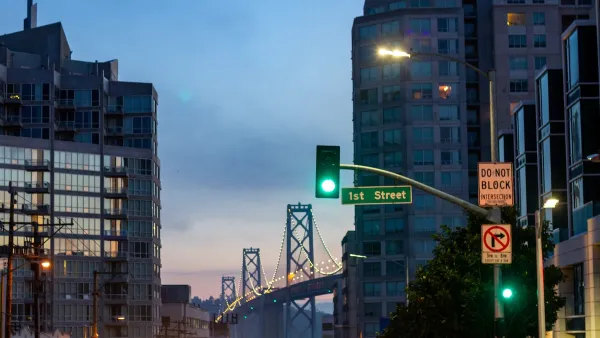
San Francisco Officials Call for Citywide Ban on Right Turns on Red
A proposal to prohibit turns on red at some downtown intersections prompted calls for a blanket ban for the entire city.

Artists Blanket Houston in Rainbow Murals After City Removes Rainbow Crosswalks
Houstonians are responding to the removal of rainbow crosswalks with new murals celebrating diversity.

Planetizen Federal Action Tracker
A weekly monitor of how Trump’s orders and actions are impacting planners and planning in America.

The state-sanctioned urbicide of Austin
People don’t kill cities. Freeways do.

US to reduce Colorado River water deliveries to Mexico
A new Colorado Treaty amendment reduces Mexico’s Colorado River water allocation by 250,000 acre feet.

Mamdani overhauls NYC's Vision Zero plan with 100 new policy goals
The overhaul aims to reduce traffic deaths and make streets safer for pedestrians, cyclists and drivers through lower speed limits, new safety infrastructure and more.

Amtrak not solely to blame for New Jersey commuter rail's unreliability, report finds
A new study from the Garden State Initiative found that NJ Transit’s budget grew 20% across a 4 year period, but reliability declined significantly over the same period.

EPA erases limits on planet-warming pollution from power plants
Under Monday’s plan, power plants would still have some limits on how much mercury, arsenic and other contaminants they can emit.

FREE Course: Walkable City 1: Why Walkability?
After describing his path towards focusing on walkability as the essence of good planning, Jeff Speck marches through his five principal reasons for making more walkable places.
Reinventing Malls: Planning Alchemy—Turning Gray Fields Into Gold
The course focuses on the opportunities and imperatives that shape reinvention of mall sites.

Eagle County Government
Harvard University Graduate School of Design
Nashville Planning Department
The Architects Foundation
University of Cincinnati Online
The Pocatello Development Authority
The Urban Renewal Agency of the City of Pocatello
Journal of the American Planning Association