Despite a recent — and slowing — apartment construction boom, renters at the lower end of the income scale are still struggling to find housing.


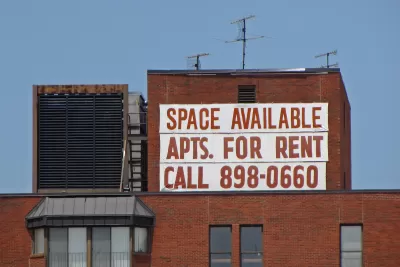
U.S. renters are seeing little relief from high housing costs despite what has been described as a boom in apartment construction, reports Patrick Sisson in a piece for Bloomberg CityLab.
According to the Harvard Joint Center for Housing Studies annual State of the Nation’s Housing Report, “the portion of the country’s renters who face significant cost burdens has hit record levels — and the strain has moved up the income ladder.” Today, 65 percent of working-age renters can’t cover their non-housing expenses after their housing costs.
If the federal government proceeds with cuts to federal housing assistance programs, the situation could get worse for low- and middle-income renters. According to Harvard senior research associate Alexander Hermann, “Affordability challenges have never been greater, and the private housing market isn’t serving those households, so this is basically the worst time to cut housing assistance for low-income households.”
The number of Americans spending more than 30 percent on housing — considered rent-burdened — hit an all-time high of 22.6 million in 2023, with 83 percent of Americans making under $30,000 per year being rent-burdened. “But those with higher salaries are affected as well: 45% of Americans making $45,000 to $74,999 a year are rent burdened, twice the 2001 rate.”
The number of housing units renting for lower costs is dropping, while “the stock of apartments renting for more than $2,000 tripled, from 3.6 to 9.1 million” between 2013 and 2023. “Beyond rent, the growth of several housing-related costs has been making apartment living more expensive. Consumer electricity costs rose 4.5% last year, double the consumer price index, amid surging demand from power-gobbling data centers.”
FULL STORY: US Renters Face Storm of Rising Costs


‘Residual Income’ Study Reveals Two-Thirds of Working Age Renters Struggle to Make Ends Meet
Half of U.S. renters are considered ‘rent burdened,’ but an even larger number of households have a hard time affording basic necessities after rent.
Rents Rose Between December and January
After dropping to a three-year low, U.S. rent costs grew in many major cities.

US Rental Housing Prices Hit Three Year Low — and Still Out of Reach
The gap between median rental prices and incomes is shrinking in the US, but still falls short of affordability.

Planetizen Federal Action Tracker
A weekly monitor of how Trump’s orders and actions are impacting planners and planning in America.

The state-sanctioned urbicide of Austin
People don’t kill cities. Freeways do.

US to reduce Colorado River water deliveries to Mexico
A new Colorado Treaty amendment reduces Mexico’s Colorado River water allocation by 250,000 acre feet.

LA Metro’s ultimatum: no extra buses for LA28 if federal funding isn’t imminently secured
If Metro does not provide additional buses, LA28 organizers will have to find a new way to manage Olympic traffic. LA28’s budget does not include a line item for transit.

Colorado’s Largest Data Center Could Rise Next to Homes — Without a Public Hearing
The proposed campus would consume 11 times the power of Denver International Airport; as it has across the country, opposition mounts.

5 New England states march closer to 800 megawatt wind energy project
Securing federal approval for the project may be complicated under the Trump administration, which has historically been hostile towards domestic wind power.

FREE Course: Walkable City 1: Why Walkability?
After describing his path towards focusing on walkability as the essence of good planning, Jeff Speck marches through his five principal reasons for making more walkable places.
Reinventing Malls: Planning Alchemy—Turning Gray Fields Into Gold
The course focuses on the opportunities and imperatives that shape reinvention of mall sites.

.png)
Eagle County Government
Harvard University Graduate School of Design
Nashville Planning Department
The Architects Foundation
University of Cincinnati Online
The Pocatello Development Authority
The Urban Renewal Agency of the City of Pocatello
Journal of the American Planning Association