Clybourne Park, a play exploring race, real estate, and community tensions, can set the stage for discussion on the lasting impacts of housing discrimination, gentrification, and the fight for affordability.


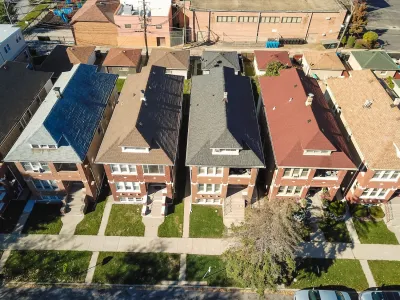
Clybourne Park, a Pulitzer- and Tony-winning play, recently staged at the Arvada Center in Colorado, uses satire and sharp dialogue to explore systemic racism, gentrification, and community identity — then and now. Set in a fictional South Chicago neighborhood, the play unfolds in two acts: the first in 1959 as a white couple sells their home to a Black family, and the second in 2009, with a white couple seeking to gentrify the same house in a now-majority-Black neighborhood.
The production, directed by Kenny Moten, highlights how deeply racism, classism, ableism, and exclusion are embedded in American society. Moten notes how these issues remain relevant today, challenging audiences to examine their role in division and disconnection.
The March 23 performance was followed by a community panel on housing issues, featuring experts from local affordable housing organizations and advocacy groups. They discussed the real-life housing crisis in Arvada — a suburb grappling with a $612,500 median home price — and the urgent need for collaboration to increase affordable housing access. Panelists emphasized how the arts can drive awareness and spark critical conversations around equity, displacement, and community futures.
Ultimately, Clybourne Park serves as both a mirror and a catalyst, encouraging audiences to reckon with the past and commit to building a more inclusive, just housing future.
Read the full story: Clybourne Park on Stage, Housing Inequity in Real Life—A Post-Show Reflection
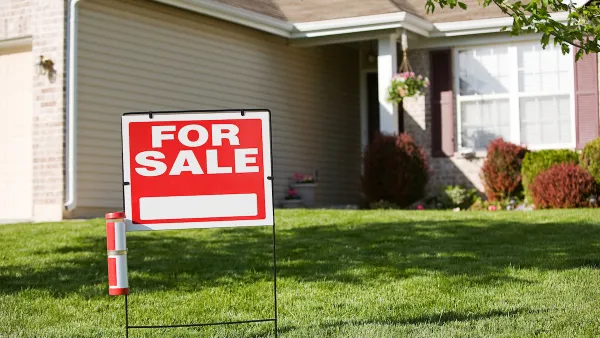
Report: Just 7 Percent of Homes for Sale Affordable to Black Households
The affordability crisis continues to impact American households across the board, with 16 percent of listings affordable to the average household.
Robert Moses, the Musical
A new musical has been written about Robert Moses and his impact on New York City. Robert A. Caro, Moses' Pulitzer Prize-winning biographer, attends a rehearsal.

Revolving loan funds: The hottest trend in housing finance
A housing policy tool is gaining momentum that could stimulate lots of mixed-income homes for a relatively small investment. Will partisan ideology stand in the way of its spread?

Planetizen Federal Action Tracker
A weekly monitor of how Trump’s orders and actions are impacting planners and planning in America.

Eastern Nebraska is running out of electricity
Data centers and electrification are straining eastern Nebraska’s grid, throttling economic development.

Study reveals best places in the U.S. for cycling, walking
New research from Streetlight Data examines bicycle and pedestrian miles per capita in the 100 largest U.S. cities by population.

Washington state to fine drivers with fuel-efficient cars
Revenue from the fine will go towards supporting the state’s highways.

Strained electrical grid forces San Francisco to choose: housing, or data centers?
The city is approaching its maximum grid capacity, leaving leaders with tough choices about what projects to siphon energy toward.

Next-generation nuclear reactors are coming to Texas
The reactors will not require towering containment structures thanks to new safety features.

FREE Course: Walkable City 1: Why Walkability?
After describing his path towards focusing on walkability as the essence of good planning, Jeff Speck marches through his five principal reasons for making more walkable places.
Reinventing Malls: Planning Alchemy—Turning Gray Fields Into Gold
The course focuses on the opportunities and imperatives that shape reinvention of mall sites.

City of Charlotte
City of Rosemead
Rutgers University, Edward J. Bloustein School of Planning and Public Policy
University of Michigan School for Environment and Sustainability (SEAS)
Hunter College, City University of New York (CUNY)
The Architects Foundation
City of Cambridge
The Pocatello Development Authority
The Urban Renewal Agency of the City of Pocatello