The system saw its highest ridership since before the Covid-19 pandemic, but faces a severe budget shortage in the coming year.


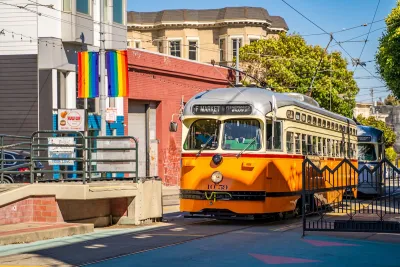
San Francisco’s Muni transit agency saw record post-pandemic ridership last year, signaling the success of Muni’s reorganization of its network to accommodate new travel patterns.
As Rachel Swan explains in the San Francisco Chronicle, “As of March, Muni had reached 75% of pre-pandemic ridership, with 158 million passenger trips last year — an increase of 13.5 million from 2023.” The system reached 78 percent of 2019 ridership in September. Some neighborhood routes recovered much more quickly, thanks in part to new bus-only lanes. For example, the 49 Van Ness line reached 143 percent of 2019 ridership last September.
“But the agency’s resurgence appears clouded by dismal budget projections for Muni,” Swan adds. “SFMTA planners are contemplating service cuts over the summer that could force some routes to turn around at Market Street, part of an effort to shore up $50 million, as the agency suffers from lost parking and general fund revenue.”
Read the full story: Muni’s retooled transit system has reached post-pandemic ridership highs


San Francisco Muni Raises Fares a Second Time
A 10–cent fare hike for adults is part of the agency’s plan to chip away at a growing budget deficit.
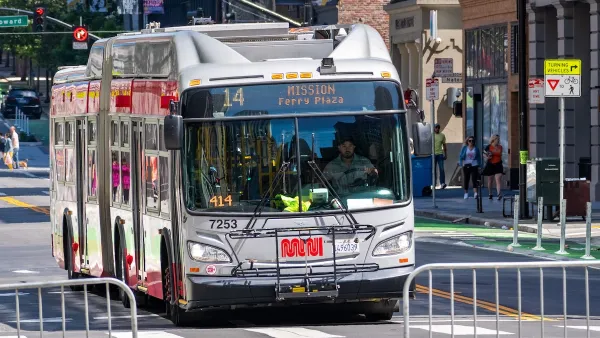
How to Fund SF’s Muni Without Cutting Service
Three solutions for bridging the San Francisco transit agency’s budget gap without reducing service for transit-dependent riders.
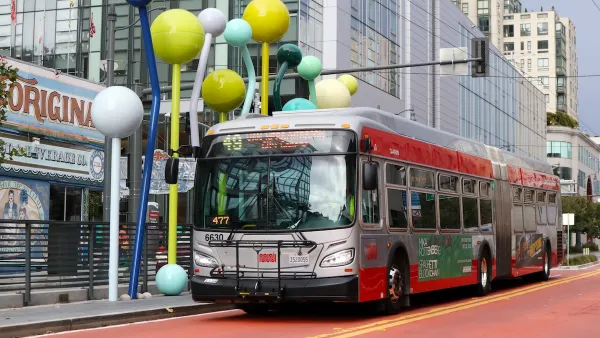
Opinion: San Francisco Needs a Well-Funded Transit System
Muni ridership is above pre-pandemic levels on some lines. Why is the agency still considering service cuts?

Planetizen Federal Action Tracker
A weekly monitor of how Trump’s orders and actions are impacting planners and planning in America.

California plans to bury El Niño’s downpour
If the state plays its cards right, it may be able to store a billion acre-feet of El Niño’s water in aquifers.

Chicago breaks ground on $3 billion megadevelopment
The new neighborhood, titled Foundry Park, will one day host 3,700 residences.

Satanic Place Names
From streams and lakes to valleys and canyons, I mapped more than 1,000 places named after the Devil.

California High-Speed Rail Authority CEO resigns after $600,000 scandal
Under Ian Choudri, the authority used taxpayer dollars to fund first class flights and trips to nightclubs.

Want to study the Missouri River? Soon, you may need unanimous approval from 10 states
Legislation would require 10 governors’ permission to study or build projects moving water outside the basin.

FREE Course: Walkable City 1: Why Walkability?
After describing his path towards focusing on walkability as the essence of good planning, Jeff Speck marches through his five principal reasons for making more walkable places.
Reinventing Malls: Planning Alchemy—Turning Gray Fields Into Gold
The course focuses on the opportunities and imperatives that shape reinvention of mall sites.

City of Rosemead
Rutgers University, Edward J. Bloustein School of Planning and Public Policy
One Hundred Miles
Hunter College, City University of New York (CUNY)
The Architects Foundation
University of Cincinnati Online
City of Cambridge
Montrose County
The Pocatello Development Authority