Gov. Hochul announced the investment just as a federal program for EV charging infrastructure was halted by administration officials.


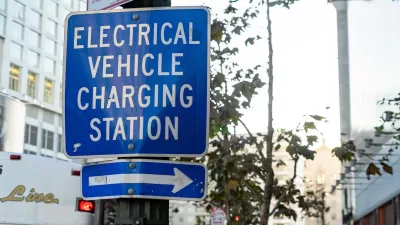
New York Governor Kathy Hochul announced a $60 million loan to electric vehicle charging infrastructure provider Revel funded via the NY Green Bank (NYGB), according to an article from the Wins Newsroom.
The loan is expected to help Revel triple its fast charger network in New York to help ease the transition to clean energy. “The funding, NYGB’s first EV charging infrastructure investment, aims to support clean transportation initiatives, reduce emissions, and expand public access to EV charging, according to Hochul.”
A proposed charging site in Maspeth, Queens with 60 stalls will be the state’s largest. “The first phase is expected to be completed within the next 12 months, with the remaining stations set to be finished by 2027.”
EV infrastructure programs around the country could lose funding if a federal order to end the National Electric Vehicle Infrastructure program is upheld.
Read the full story: Hochul announces $60M for EV infrastructure in NY; Queens will be home to largest charging station in Northeast

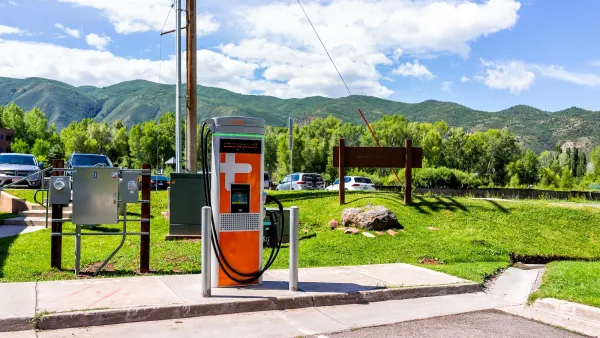
USDOT Cancels Over $100 Million in Sustainable Transportation Funds for Colorado
The administration is pulling funding for what it calls “woke” and “redundant” clean energy projects including EV charging infrastructure.
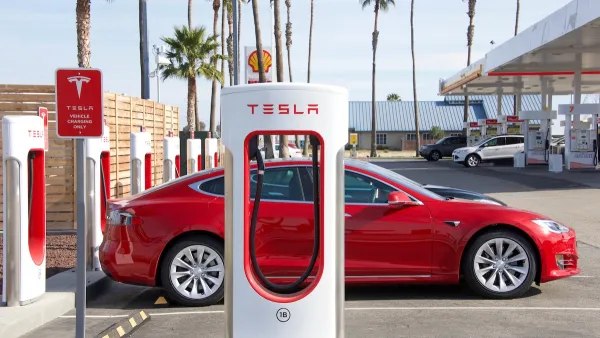
Trump's New Move Makes Gas Stations the new EV Charging Hot Spot
The revised National Electric Vehicle Infrastructure program guidance prioritizes funding for projects sited on locations owned by the EV charging operator and near existing amenities.
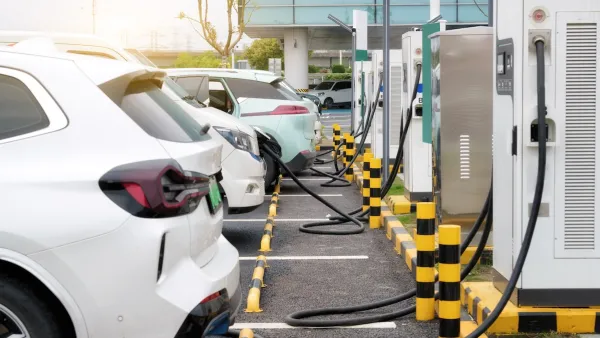
USDOT Issues New Rules for EV Charging Grants After Judge Forces Administration to Unfreeze Funds
The Trump administration is reviving the National Electric Vehicle Infrastructure program, revising its guidelines to eliminate consumer protections, environmental reviews, labor standards, and other provisions from the Biden-era program.

Planetizen Federal Action Tracker
A weekly monitor of how Trump’s orders and actions are impacting planners and planning in America.

California plans to bury El Niño’s downpour
If the state plays its cards right, it may be able to store a billion acre-feet of El Niño’s water in aquifers.

Chicago breaks ground on $3 billion megadevelopment
The new neighborhood, titled Foundry Park, will one day host 3,700 residences.

California High-Speed Rail Authority CEO resigns after $600,000 scandal
Under Ian Choudri, the authority used taxpayer dollars to fund first class flights and trips to nightclubs.

Want to study the Missouri River? Soon, you may need unanimous approval from 10 states
Legislation would require 10 governors’ permission to study or build projects moving water outside the basin.

Desperate measures: Advocates weigh draining Lake Powell to fill Colorado River
Draining the reservoir could reduce evaporation losses by a couple hundred thousand acre-feet.

FREE Course: Walkable City 1: Why Walkability?
After describing his path towards focusing on walkability as the essence of good planning, Jeff Speck marches through his five principal reasons for making more walkable places.
Reinventing Malls: Planning Alchemy—Turning Gray Fields Into Gold
The course focuses on the opportunities and imperatives that shape reinvention of mall sites.

City of Rosemead
Rutgers University, Edward J. Bloustein School of Planning and Public Policy
One Hundred Miles
Hunter College, City University of New York (CUNY)
The Architects Foundation
University of Cincinnati Online
City of Cambridge
Montrose County
The Pocatello Development Authority