Current state law prohibits cars from parking more than 12 inches away from a curb, but does not take into account bike lanes or pedestrian spaces placed between the curb and parking lanes.


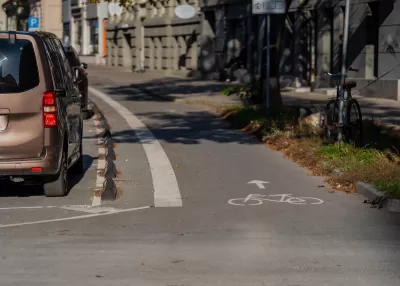
The Pennsylvania House Transportation Committee voted unanimously to advance a bill that would advance bike safety, according to a report by John Cole in the Pennsylvania Capital-Star. “House Bill 291, sponsored by state Reps. Mary Jo Daley (D-Montgomery) and David Maloney (R-Berks), would allow municipalities to create parking-protected bicycle lanes between curbs and parked vehicles, allowing bicyclists to ride separated from vehicular traffic.“
As Cole explains, this would give local jurisdictions the ability to install pedestrian plazas and protected bike lanes. The bill would not mandate any new bike lanes, but would eliminate the current requirement that vehicles park within 12 inches of a curb.
According to Cole, “In the previous session, the bill was also unanimously approved by the House Transportation Committee and was passed by the full state House by a 198-5 vote, however it was not approved by the Senate.”
The committee also advanced House Bill 257, which would require driving tests to include questions about safe driving in work zones.
Read the full story: Pa. House committee unanimously backs bike lane legislation
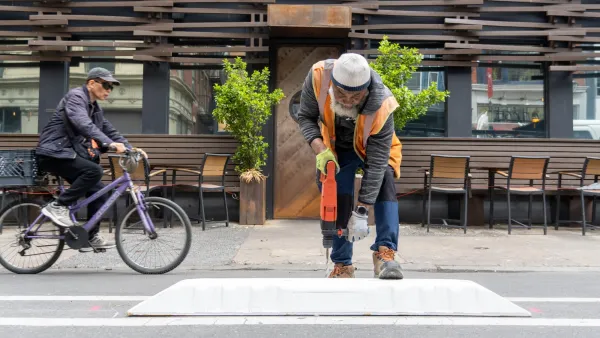
Philadelphia adds new safety measures to 13th Street bike lane
The city is piloting plastic, modular bike lane separators that buffer cyclists from the adjacent vehicle lane.

El Paso has Built 1,000 Miles of Bike Lanes in 10 Years
The city is now asking the public for input on updates to its bike plan.
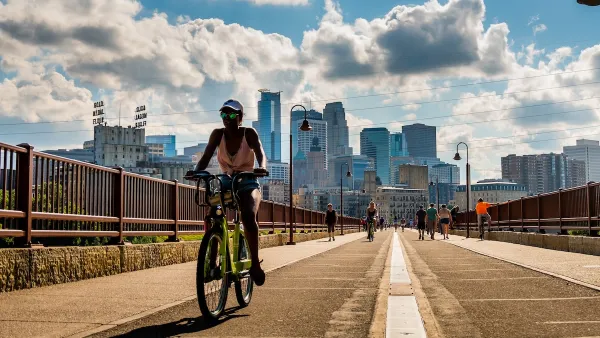
The 5 Safest Cities for Cyclists in America — and What They Have in Common
Cities with low fatality rates for people on bikes have made strong commitments to building safe, protected bike networks and supporting Complete Streets.

Planetizen Federal Action Tracker
A weekly monitor of how Trump’s orders and actions are impacting planners and planning in America.

California plans to bury El Niño’s downpour
If the state plays its cards right, it may be able to store a billion acre-feet of El Niño’s water in aquifers.

Desperate measures: Advocates weigh draining Lake Powell to fill Colorado River
Draining the reservoir could reduce evaporation losses by a couple hundred thousand acre-feet.

In Texas, data centers are swallowing promised parkland
Residents who moved to Taylor, Texas for a rural community now have to contend with three data centers in their backyard.

How a Chicago-sized wind farm beat the odds and powered on
The project spanned five presidential administrations and a standoff with a U.S. military base.

MTA gives itself 30 days to transform pit into basketball court
The site has been under construction since 2022; the city originally estimated it would finish the court in 2024.

FREE Course: Walkable City 1: Why Walkability?
After describing his path towards focusing on walkability as the essence of good planning, Jeff Speck marches through his five principal reasons for making more walkable places.
Reinventing Malls: Planning Alchemy—Turning Gray Fields Into Gold
The course focuses on the opportunities and imperatives that shape reinvention of mall sites.

City of Rosemead
Rutgers University, Edward J. Bloustein School of Planning and Public Policy
One Hundred Miles
Hunter College, City University of New York (CUNY)
The Architects Foundation
University of Cincinnati Online
City of Cambridge
Montrose County
The Pocatello Development Authority