"Second generation traffic calming" -- removing traffic controls and allowing people and cars to mix freely -- has been successful in Europe and is catching on in the U.K.


"It's called 'second generation' traffic calming, a combination of traffic engineering and urban design...In practice, it's about dismantling barriers: between the road and the sidewalk, between cars, pedestrians and cyclists and, most controversially, between moving vehicles and children at play...
The shared-street concept is also intriguing for the way it challenges one of the fundamental tenets of American urban planning: that to create safe communities, you have to control them...
...Hamilton-Baillie argues that the key to improving both safety and vehicular capacity is to remove traffic lights and other controls, such as stop signs and the white and yellow lines dividing streets into lanes. Without any clear right-of-way, he says, motorists are forced to slow down to safer speeds, make eye contact with pedestrians, cyclists and other drivers, and decide among themselves when it is safe to proceed...
Research has shown that fatality rates at busy intersections, where two or three people were being killed every year, dropped to zero when controls and boundaries were taken away."
[This article is only available to paying subscribers.]
Thanks to Miles Hochstein
Read the full story: Why don't we do it in the road?


Planetizen Federal Action Tracker
A weekly monitor of how Trump’s orders and actions are impacting planners and planning in America.

‘Going backwards:’ Baltimore mayor, students rally against state's transit funding plan
Maryland's proposed six-year plan provides no funding for Baltimore’s BMORE bus program and reduces its road maintenance funding.
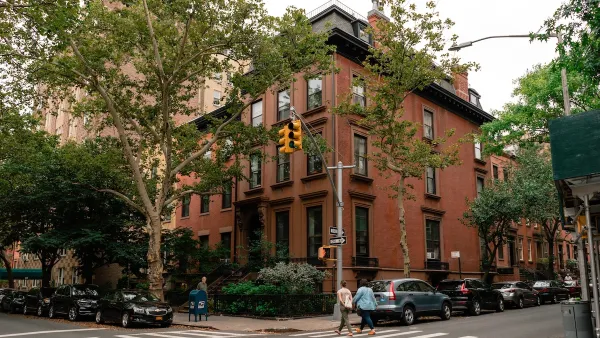
Mamdani sent nearly 6,000 pied-à-terre tax warnings to homes that didn’t qualify
A judge has ordered the administration to cancel thousands of pied-à-terre tax notices after it sent 35% of them erroneously.

A Colorado neighborhood is the testing ground for the future of home energy
A start up may have found a way to quickly bring geothermal energy to new communities.

Mamdani sent nearly 6,000 pied-à-terre tax warnings to homes that didn’t qualify
A judge has ordered the administration to cancel thousands of pied-à-terre tax notices after it sent 35% of them erroneously.

Detroit to transform waterfront with $2.2 billion investment
Developers will convert about 18 acres of unused parking lot space into civic spaces.

FREE Course: Walkable City 1: Why Walkability?
After describing his path towards focusing on walkability as the essence of good planning, Jeff Speck marches through his five principal reasons for making more walkable places.
Reinventing Malls: Planning Alchemy—Turning Gray Fields Into Gold
The course focuses on the opportunities and imperatives that shape reinvention of mall sites.

City of Thousand Oaks
City of Wisconsin Rapids
Harvard University Graduate School of Design
The Architects Foundation
University of Cincinnati Online
Northern Illinois Transit Authority (NITA)
The Pocatello Development Authority
The Urban Renewal Agency of the City of Pocatello