Housing developers will no longer be required to dedicate land to roadway widening, which could significantly reduce the cost of construction and support more housing units.


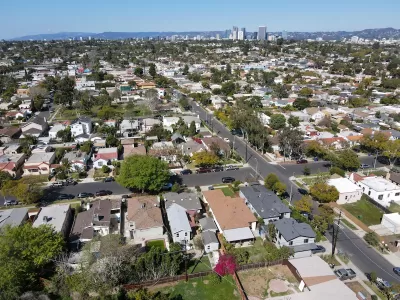
Among the raft of bills signed by California Governor Newsom last week is Assembly Bill 3177, which prohibits local governments and agencies from requiring road widening next to new housing developments to achieve higher traffic flow, known as “level of service,” or “to achieve a desired roadway width.”
Under the new law, local governments would need to provide “substantial evidence” to require setting aside land for new roadway space, explains Melanie Curry in Streetsblog California. The law explicitly calls out a Los Angeles city law that calls for piecemeal “spot widening” in front of new developments, which often results in a zig-zag pattern that doesn’t improve traffic and eliminates thousands of square feet of land that could have been used for additional housing. While AB 3177 will eliminate this requirement for residential projects, the Los Angeles law will still apply to other types of developments.
According to the bill’s analysis, “A 2016 research study published in the Journal of Transport and Land Use found that road widening requirements in Los Angeles can cost developers over $10,000 per unit, resulting in up to hundreds of thousands of dollars being added to projects subjected to these requirements in certain instances.”
FULL STORY: Legislative Update: Ending Harmful Road Widening, and Redefining “Major Transit Stops”

Analysis: DC needs tens of thousands of new homes — not just 'zoned capacity'
Estimates for Washington DC's housing needs range from 15,000 to 170,000.

Austin's building boom fails to reach the poorest residents
Although the city has built thousands of new homes, few of them are available to the lowest-earning households.

Oakland opens first affordable housing for teachers
The school district says 70% of its teachers can't afford to live in Oakland.

Planetizen Federal Action Tracker
A weekly monitor of how Trump’s orders and actions are impacting planners and planning in America.

The state-sanctioned urbicide of Austin
People don’t kill cities. Freeways do.

US to reduce Colorado River water deliveries to Mexico
A new Colorado Treaty amendment reduces Mexico’s Colorado River water allocation by 250,000 acre feet.

Mamdani overhauls NYC's Vision Zero plan with 100 new policy goals
The overhaul aims to reduce traffic deaths and make streets safer for pedestrians, cyclists and drivers through lower speed limits, new safety infrastructure and more.

Amtrak not solely to blame for New Jersey commuter rail's unreliability, report finds
A new study from the Garden State Initiative found that NJ Transit’s budget grew 20% across a 4 year period, but reliability declined significantly over the same period.

EPA erases limits on planet-warming pollution from power plants
Under Monday’s plan, power plants would still have some limits on how much mercury, arsenic and other contaminants they can emit.

FREE Course: Walkable City 1: Why Walkability?
After describing his path towards focusing on walkability as the essence of good planning, Jeff Speck marches through his five principal reasons for making more walkable places.
Reinventing Malls: Planning Alchemy—Turning Gray Fields Into Gold
The course focuses on the opportunities and imperatives that shape reinvention of mall sites.

Eagle County Government
Harvard University Graduate School of Design
Nashville Planning Department
The Architects Foundation
University of Cincinnati Online
The Pocatello Development Authority
The Urban Renewal Agency of the City of Pocatello
Journal of the American Planning Association