The city is doubling down on its efforts to boost bus ridership as part of its climate action plan.


Tucson, Arizona is offering free bus rides for at least another year as part of the city’s effort to expand public transit ridership, according to a piece in Yale Climate Connections. The city began offering free transit during the Covid-19 pandemic and has repeatedly renewed the program.
But fare cost isn’t the only challenge to boosting ridership, Fátima Luna, Tucson’s Chief Resilience Officer, acknowledges. A lack of shade at nearly half of the city’s bus stops is another factor that prevents people from safely and comfortably riding buses. “So as part of a pilot project, the city will install shade structures and plant trees and other vegetation at a handful of stops. They’ll measure how these changes affect temperature — and plan to implement the most effective strategies more widely.”
Last year, Tucson began implementing a climate action plan to address extreme heat and provide cooling centers and other mitigation measures.
Read the full story: Tucson, Arizona, bets on buses

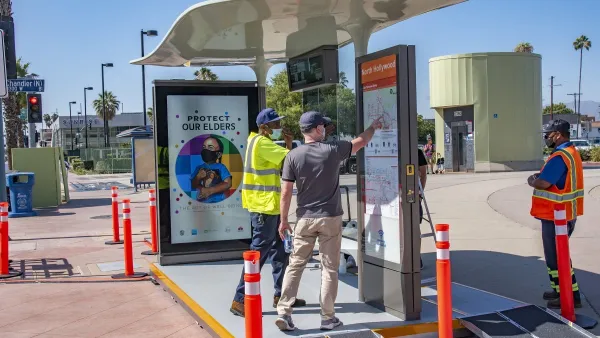
LA Begins Adding New Bus Shelters
The program, years in the works, pledges to add 3,000 new bus shelters and 450 shade structures to protect riders from extreme heat and weather.
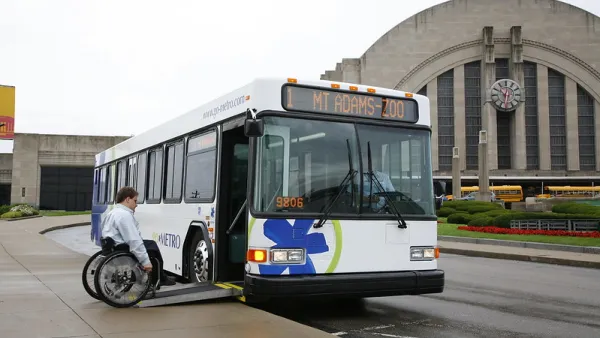
Gas Too Expensive? Cincinnati Metro Has You Covered With Free Rides
Cincinnati residents and visitors will have access to free transit for a week as the agency aims to boost ridership.
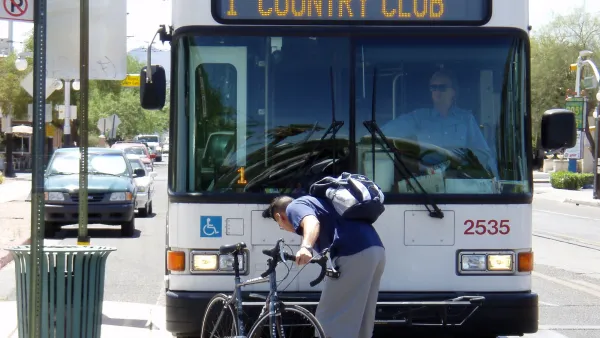
Tucson plans to keep free transit despite budget shortfall
Tucson's buses have been fare-free since March 2020.

Planetizen Federal Action Tracker
A weekly monitor of how Trump’s orders and actions are impacting planners and planning in America.

California plans to bury El Niño’s downpour
If the state plays its cards right, it may be able to store a billion acre-feet of El Niño’s water in aquifers.

Chicago breaks ground on $3 billion megadevelopment
The new neighborhood, titled Foundry Park, will one day host 3,700 residences.

California High-Speed Rail Authority CEO resigns after $600,000 scandal
Under Ian Choudri, the authority used taxpayer dollars to fund first class flights and trips to nightclubs.

Want to study the Missouri River? Soon, you may need unanimous approval from 10 states
Legislation would require 10 governors’ permission to study or build projects moving water outside the basin.

Desperate measures: Advocates weigh draining Lake Powell to fill Colorado River
Draining the reservoir could reduce evaporation losses by a couple hundred thousand acre-feet.

FREE Course: Walkable City 1: Why Walkability?
After describing his path towards focusing on walkability as the essence of good planning, Jeff Speck marches through his five principal reasons for making more walkable places.
Reinventing Malls: Planning Alchemy—Turning Gray Fields Into Gold
The course focuses on the opportunities and imperatives that shape reinvention of mall sites.


City of Rosemead
Rutgers University, Edward J. Bloustein School of Planning and Public Policy
One Hundred Miles
Hunter College, City University of New York (CUNY)
The Architects Foundation
University of Cincinnati Online
City of Cambridge
Montrose County
The Pocatello Development Authority