Budding developers can access funding and low-cost vacant lots for affordable housing construction.


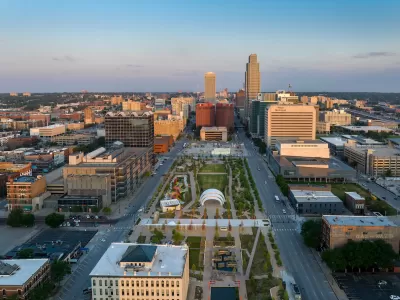
A symposium organized by the Omaha Municipal Land Bank and the nonprofit Spark brought together local developers interested in developing infill properties, reports Cindy Gonzales in the Nebraska Examiner.
The symposium also connected emerging developers, bankers, architects, and others interested in housing development. According to Land Bank executive director Leslie Smith, encouraging infill development could have community benefits beyond just new housing, raising local property values. One such project, ‘Curtis Corner,’ built nine new homes on a formerly vacant lot in North Omaha.
The city recently sold 50 properties for as low as $1 with one catch: the new owners have a deadline to develop housing on the lots. “And as long as the homes are restricted for the designated income-qualified population, the buyer can access gap funding from nonprofit sources such as the local Spark Capital program to bridge the cost between construction and sale price.” The Land Bank is using a $1.25 million state grant to clean up and prepare 20 or more lots for building.
Read the full story: Unprecedented moves seek to ramp up affordable housing options in Omaha

Mayor Mamdani unveils map of 100 public lots that could become housing
The city identified properties that could be available for new housing development.
A South Dakota hospital is funding a new subdivision for its employees
Some employees see investing in housing as the only way to stem the loss of workers moving away due to high housing costs.
Boston's 'sliver lots' could yield over 1,500 affordable homes
The city has identified over 500 vacant parcels suitable for infill housing.

Planetizen Federal Action Tracker
A weekly monitor of how Trump’s orders and actions are impacting planners and planning in America.

Amtrak, CN end decades-long dispute with eight-year agreement
The new operating agreement establishes an updated framework for the companies to work together, including processes to resolve disputes.

Judges permit Denver to divert 77,000 acre feet from the Colorado River for reservoir expansion
Overuse and climate change have caused the Colorado River’s water levels to plummet.

Maryland local governments examine if they should have more power to raise property taxes
Maryland’s housing market is out of reach for the majority of moderate-income residents.

Northwest rail fans eager for Sept. 30 debut of Amtrak’s Airo fleet
Get ready for that new train smell and more seats. But they won’t go faster or run more frequently on the Cascades route in Washington and Oregon.

NYC DOT wants faster, more permanent street upgrades
The city is examining ways to build more concrete infrastructure without getting entangled in 'decades-long' projects.

FREE Course: Walkable City 1: Why Walkability?
After describing his path towards focusing on walkability as the essence of good planning, Jeff Speck marches through his five principal reasons for making more walkable places.
Reinventing Malls: Planning Alchemy—Turning Gray Fields Into Gold
The course focuses on the opportunities and imperatives that shape reinvention of mall sites.

Harvard University Graduate School of Design
KFH Group Inc.
Greater Baltimore Committee
The Architects Foundation
University of Cincinnati Online
The Pocatello Development Authority
The Urban Renewal Agency of the City of Pocatello