While state leaders remain silent, federal transportation officials are touting the proposed project’s benefits.


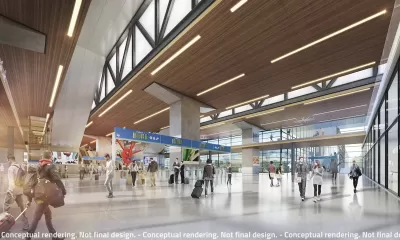
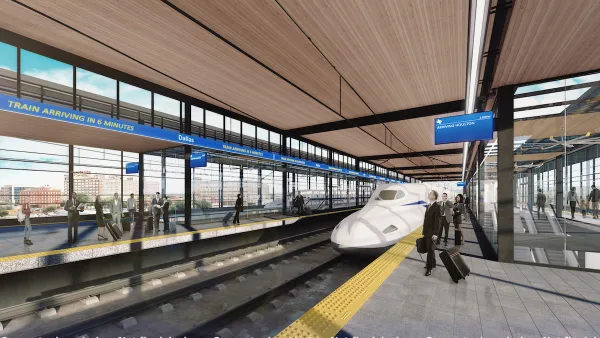
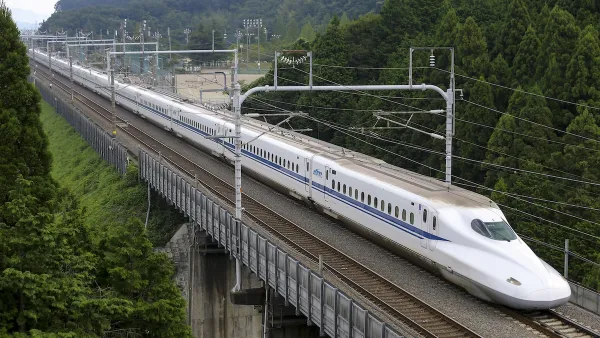
Plans for a high-speed train between Dallas and Houston are becoming more and more real as passenger rail projects around the nation gain steam, reports Benjamin Schneider in Bloomberg CityLab. Texas Central, the authority overseeing the project, says the project would use Japanese Shinkansen technology, a type of high-speed rail not yet available in the United States.
“The 240-mile Dallas to Houston corridor, with a stop in the Brazos Valley serving Texas A&M University, is ideal for high-speed rail,” according to Amtrak’s Senior Vice President for High-Speed Rail Development Programs Andy Byford. But the project would cost upwards of $30 billion and require the acquisition of private property. Meanwhile, the state has remained silent on any level of financial support.
Hopes for the project, which was first proposed in 2009, grew last year when Amtrak and Texas Central announced they are ‘exploring’ a partnership that would have Amtrak operate the future line. “How, exactly, Texas Central and Amtrak would work together remains unclear.” A 2017 Texas law outlaws using state funds for privately operated high-speed rail, but Schneider points out that “It’s not clear whether an Amtrak-led but partially privately funded project would be barred from funding under this law.”
Read the full story: The Dream of a Texas Bullet Train Lives On

High-Speed Rail Tracker
Smart Cities Dive follows high-speed rail developments around the country
Texas Central Railway Could Have “Massive Positive Impact”
Amtrak took the lead on the proposed high-speed rail project, which would connect Houston and Dallas in less than 90 minutes.
Will Texas High-Speed Rail Become a Reality?
A proposed Houston-to-Dallas rail line shows promise, but faces major hurdles before it can come to fruition.

Planetizen Federal Action Tracker
A weekly monitor of how Trump’s orders and actions are impacting planners and planning in America.

Amtrak, CN end decades-long dispute with eight-year agreement
The new operating agreement establishes an updated framework for the companies to work together, including processes to resolve disputes.

Judges permit Denver to divert 77,000 acre feet from the Colorado River for reservoir expansion
Overuse and climate change have caused the Colorado River’s water levels to plummet.

How ‘post-disaster gentrification’ alters neighborhoods after natural calamities
After hurricanes, fires or other calamities, the original residents of a community are often replaced by younger, wealthier residents.

Maryland local governments examine if they should have more power to raise property taxes
Maryland’s housing market is out of reach for the majority of moderate-income residents.

Northwest rail fans eager for Sept. 30 debut of Amtrak’s Airo fleet
Get ready for that new train smell and more seats. But they won’t go faster or run more frequently on the Cascades route in Washington and Oregon.

FREE Course: Walkable City 1: Why Walkability?
After describing his path towards focusing on walkability as the essence of good planning, Jeff Speck marches through his five principal reasons for making more walkable places.
Reinventing Malls: Planning Alchemy—Turning Gray Fields Into Gold
The course focuses on the opportunities and imperatives that shape reinvention of mall sites.

Harvard University Graduate School of Design
KFH Group Inc.
Greater Baltimore Committee
The Architects Foundation
University of Cincinnati Online
The Pocatello Development Authority
The Urban Renewal Agency of the City of Pocatello