The Arizona Department of Transportation announced a public-private partnership to install fiber-optic infrastructure along 405 miles of interstate highways to enable vehicle connectivity.


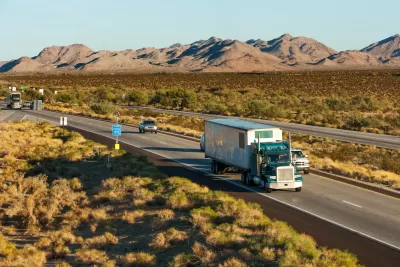
A new project announced in April will lay the groundwork for connected and automated vehicles in Arizona, according to a Gov Tech article by Skip Descant. “The project, a partnership among the Arizona Department of Transportation (ADOT), the Arizona Commerce Authority and eX2 Technology…will lay 405 miles of fiber along interstates 40, 19 and 17,” Descant reports.
The project, which is expected to begin later this year, will serve dual purposes: a ‘testbed” for intelligent transportation systems technology and “middle-mile” broadband “intended to build out the infrastructure needed to support final ‘last-mile’ connections to homes and businesses,” particularly those in rural areas and on tribal lands. In addition to connected and automated vehicles, an ADOT representative told Gov Tech the new fiber infrastructure will support overhead message boards, traffic cameras, weather stations, and wrong-way driving detection.
“The project is seen as a significant advancement of the national goal to bring broadband to unserved and underserved areas. Arizona received more than $993.1 million from the Broadband Equity Access and Deployment (BEAD) Program, part of the 2021 federal Infrastructure Investment and Jobs Act,” writes Descant.
FULL STORY: Arizona Fiber Work Will Connect Vehicles and Residents

The 'Worst-Connected Cities' in the United States
Here are the cities where residents are the least likely to have a broadband Internet connection in their home.
Mapping the Gap Between Broadband Access and Broadband Subscription
Not everyone that has access to high-quality Internet infrastructure is making use of it.
San Antonians Angry About Huts, Google Fiber's Fast Internet Plan Hits a Speedbump
Some in Texas are worried about the structures that house Google's Fiberoptic Cables, complaining that the huts are ugly and take up too much park space.

Planetizen Federal Action Tracker
A weekly monitor of how Trump’s orders and actions are impacting planners and planning in America.

The state-sanctioned urbicide of Austin
People don’t kill cities. Freeways do.

US to reduce Colorado River water deliveries to Mexico
A new Colorado Treaty amendment reduces Mexico’s Colorado River water allocation by 250,000 acre feet.

5 New England states march closer to 800 megawatt wind energy project
Securing federal approval for the project may be complicated under the Trump administration, which has historically been hostile towards domestic wind power.

Baltimore to break ground on $50 million Transit Priority Project
The project will bring faster bus trips, safer streets and better bike connections to Baltimore.

Airbnb launches $250 million 'last-dollar financing' housing accelerator, makes first investment in Austin
The company will put $6.4 million towards affordable housing development in Texas’ capital.

FREE Course: Walkable City 1: Why Walkability?
After describing his path towards focusing on walkability as the essence of good planning, Jeff Speck marches through his five principal reasons for making more walkable places.
Reinventing Malls: Planning Alchemy—Turning Gray Fields Into Gold
The course focuses on the opportunities and imperatives that shape reinvention of mall sites.

Eagle County Government
Harvard University Graduate School of Design
Nashville Planning Department
The Architects Foundation
University of Cincinnati Online
The Pocatello Development Authority
The Urban Renewal Agency of the City of Pocatello
Journal of the American Planning Association