The FY 2025 budget includes a new tax incentive, funding for affordable housing on state land, and support for adaptive reuse and ADUs.



New York Governor Kathy Hochul announced a package of policies aimed at stemming the housing crisis and improving affordability for renters and homeowners as part of the FY 2025 Enacted Budget.
According to a press release from the governor’s office, the package includes new tax incentives for development in New York City, new incentives for adaptive reuse, a $500 million capital fund for building housing on state-owned land, and new renter and homeowner protections. “For localities outside of New York City, the Budget includes an opt-in tax incentive program for mixed-income and 100 percent affordable new construction or conversion multifamily rental projects, and an incentive to create accessory dwelling units (ADUs).”
An article in Politico notes that the policy shift signals that politicians are feeling “the political weight of the growing crisis,” and that soaring costs are wearing down the city’s “trademark NIMBYism.” However, lawmakers backed away from a prior proposal to “force localities, particularly the suburbs around New York City, to grow their housing stock” in response to pressure from suburban groups.


‘City of Yes’ Zoning Reform Gains Planning Commission Approval
The proposal to overhaul New York City’s zoning code, popular with voters, to make housing development easier faces opposition in the City Council.

NYC Council Approves Brooklyn Rezoning Plan
The Atlantic Avenue Mixed Use Plan includes infrastructure investments and could bring 4,600 new housing units to parts of Brooklyn.
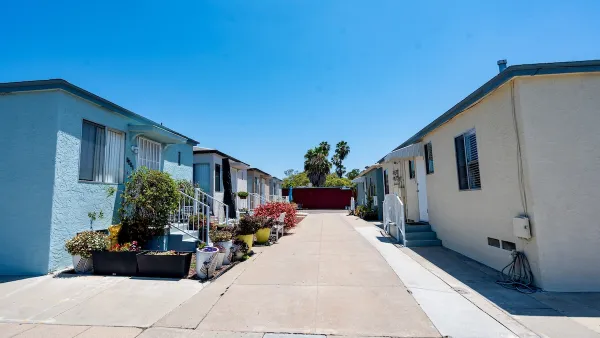
San Diego Begins to See Results of State Housing Law
Homeowners in Southern California are starting to take advantage of a state law that allows lot splitting and higher density in residential areas in an effort to increase housing supply and affordability.

Planetizen Federal Action Tracker
A weekly monitor of how Trump’s orders and actions are impacting planners and planning in America.

The state-sanctioned urbicide of Austin
People don’t kill cities. Freeways do.

US to reduce Colorado River water deliveries to Mexico
A new Colorado Treaty amendment reduces Mexico’s Colorado River water allocation by 250,000 acre feet.

5 New England states march closer to 800 megawatt wind energy project
Securing federal approval for the project may be complicated under the Trump administration, which has historically been hostile towards domestic wind power.

Baltimore to break ground on $50 million Transit Priority Project
The project will bring faster bus trips, safer streets and better bike connections to Baltimore.

Airbnb launches $250 million 'last-dollar financing' housing accelerator, makes first investment in Austin
The company will put $6.4 million towards affordable housing development in Texas’ capital.

FREE Course: Walkable City 1: Why Walkability?
After describing his path towards focusing on walkability as the essence of good planning, Jeff Speck marches through his five principal reasons for making more walkable places.
Reinventing Malls: Planning Alchemy—Turning Gray Fields Into Gold
The course focuses on the opportunities and imperatives that shape reinvention of mall sites.

Eagle County Government
Harvard University Graduate School of Design
Nashville Planning Department
The Architects Foundation
University of Cincinnati Online
The Pocatello Development Authority
The Urban Renewal Agency of the City of Pocatello
Journal of the American Planning Association