A state bill that would allow multifamily buildings to only include one staircase could help boost the housing supply and encourage more spacious and well-designed apartments.



The Los Angeles Times Editorial Board is getting behind the movement for single-staircase reform, which proponents argue would create the opportunity for more housing.
The editorial highlights Assembly Bill 835, which “would direct the State Fire Marshal to propose standards to allow multifamily buildings with one stairway while still protecting residents, which could make it easier to build small-to-medium sized complexes on small lots.”
Single-staircase buildings were outlawed in many U.S. cities and states in the early 20th century as part of an effort to improve fire safety in multifamily buildings. “In recent years, however, indoor sprinklers and fire-safe construction have become common in new buildings, and architects and housing advocates argue that the two-stairway requirement should be reconsidered.”
The two-staircase requirement has eliminated building designs common in other countries that provide more variety and opportunities for community, while data suggests that there is no difference in fire safety given other modern fire standards.
The editorial board acknowledges that allowing single-stair buildings wouldn’t solve the housing crisis, but it could join other policy solutions such as ADUs in alleviating the shortage and creating more interesting and comfortable buildings. “The change would give architects more flexibility in designing larger units for families, with shared courtyards, more light and ventilation.”
FULL STORY: Editorial: How changing the rules on stairways could help California build more homes


Instead of Restricting Development, One Minnesota City Just Approved Flurry of ‘Experimental’ Housing Types
New Ulm leaders are approving multiple projects including tiny homes, apartments, and ‘shed homes’ using Planned Unit Developments to move projects forward faster.

Amidst Colorado Affordability Crisis, Just 3% of Residential Land Zoned for Multifamily Housing
A new report suggests loosening restrictive zoning laws on multifamily development could help bring down high housing costs.
More Apartments Are Being Built in Less-Dense Areas
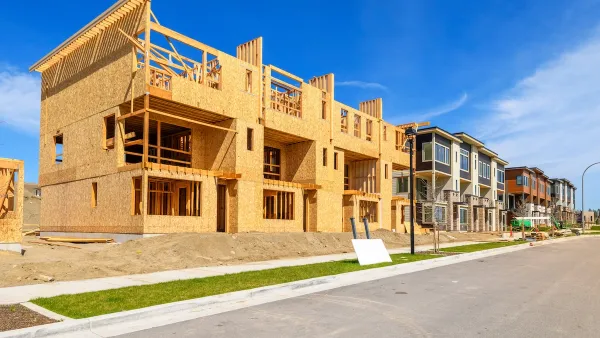
Rising housing costs in urban cores and a demand for rental housing is driving more multifamily development to exurbs and small metros.

Planetizen Federal Action Tracker
A weekly monitor of how Trump’s orders and actions are impacting planners and planning in America.

The state-sanctioned urbicide of Austin
People don’t kill cities. Freeways do.

US to reduce Colorado River water deliveries to Mexico
A new Colorado Treaty amendment reduces Mexico’s Colorado River water allocation by 250,000 acre feet.

Mamdani overhauls NYC's Vision Zero plan with 100 new policy goals
The overhaul aims to reduce traffic deaths and make streets safer for pedestrians, cyclists and drivers through lower speed limits, new safety infrastructure and more.

Amtrak not solely to blame for New Jersey commuter rail's unreliability, report finds
A new study from the Garden State Initiative found that NJ Transit’s budget grew 20% across a 4 year period, but reliability declined significantly over the same period.

EPA erases limits on planet-warming pollution from power plants
Under Monday’s plan, power plants would still have some limits on how much mercury, arsenic and other contaminants they can emit.

FREE Course: Walkable City 1: Why Walkability?
After describing his path towards focusing on walkability as the essence of good planning, Jeff Speck marches through his five principal reasons for making more walkable places.
Reinventing Malls: Planning Alchemy—Turning Gray Fields Into Gold
The course focuses on the opportunities and imperatives that shape reinvention of mall sites.

Eagle County Government
Harvard University Graduate School of Design
Nashville Planning Department
The Architects Foundation
University of Cincinnati Online
The Pocatello Development Authority
The Urban Renewal Agency of the City of Pocatello
Journal of the American Planning Association