The region’s long-range transportation plan fails to boost investment in transit, opting to fund road expansions instead.


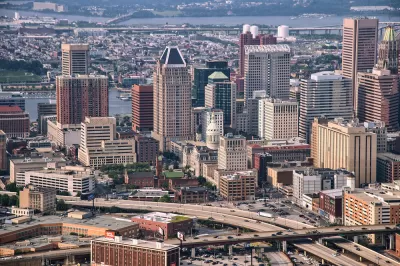
In a commentary published in The Baltimore Sun, Samuel Jordan, Eric Norton, and Michael Scepaniak excoriate Baltimore’s new regional transportation plan, known as Resilience 2050, which the authors argue “represents the same business-as-usual, automobile-centric approach Maryland has largely been taking for the past 70 years.”
According to the article, “the plan calls for almost $7 billion, the majority of system expansion spending, to go toward expanding roads and highways.” And while the plan includes almost $5 billion for new transit projects, “any progress on transit expansion would be swamped by the additional miles of new road lanes.”
As the authors point out, “History has proved that trying to build our way out of congestion with more lane miles is a failed strategy.” Now, “It’s time to plan for a transportation system that works for everyone and every community in our region — urban, suburban or rural. We need a system that gives us choices, grows the economy, is safe for everyone (including cyclists, pedestrians and people with disabilities), and helps us reduce carbon emissions.”
FULL STORY: Baltimore region’s new transportation blueprint: more of the same car-focused bad ideas

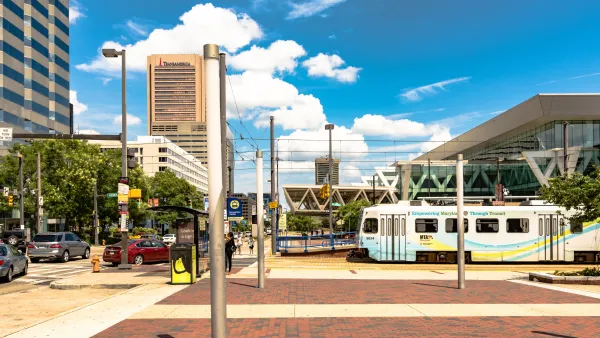
Baltimore Close to Approving $70 Billion Transportation Plan
The region’s proposed long-range plan includes over $11 billion for transit projects.
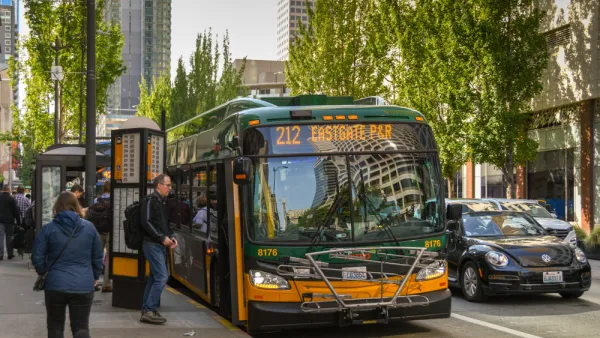
Puget Sound Transportation Plan Fails to Meet Climate Targets
Agency staff says the Puget Sound regional long-range plan won’t achieve 2030 sustainability goals set by the state.
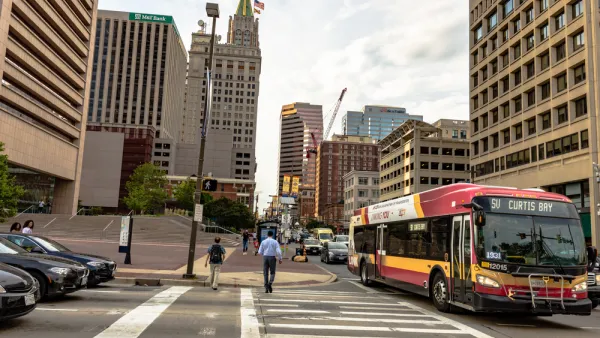
Central Maryland Regional Transit Plan: First Regional Transit Plan for Baltimore Since 2002
Transit planners in the Baltimore area are working on plans for a more reliable, useful regional transit system.

Planetizen Federal Action Tracker
A weekly monitor of how Trump’s orders and actions are impacting planners and planning in America.

The state-sanctioned urbicide of Austin
People don’t kill cities. Freeways do.

US to reduce Colorado River water deliveries to Mexico
A new Colorado Treaty amendment reduces Mexico’s Colorado River water allocation by 250,000 acre feet.

5 New England states march closer to 800 megawatt wind energy project
Securing federal approval for the project may be complicated under the Trump administration, which has historically been hostile towards domestic wind power.

Baltimore to break ground on $50 million Transit Priority Project
The project will bring faster bus trips, safer streets and better bike connections to Baltimore.

Airbnb launches $250 million 'last-dollar financing' housing accelerator, makes first investment in Austin
The company will put $6.4 million towards affordable housing development in Texas’ capital.

FREE Course: Walkable City 1: Why Walkability?
After describing his path towards focusing on walkability as the essence of good planning, Jeff Speck marches through his five principal reasons for making more walkable places.
Reinventing Malls: Planning Alchemy—Turning Gray Fields Into Gold
The course focuses on the opportunities and imperatives that shape reinvention of mall sites.

Eagle County Government
Harvard University Graduate School of Design
Nashville Planning Department
The Architects Foundation
University of Cincinnati Online
The Pocatello Development Authority
The Urban Renewal Agency of the City of Pocatello
Journal of the American Planning Association