Facing a $750 million ‘fiscal cliff,’ the agency says it’s important to continue looking forward to ‘visionary’ future plans.


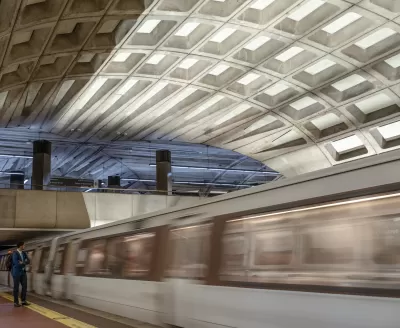
The Washington Metropolitan Area Transit Authority (Metro) announced ambitious goals to add new buses or even a rail line to its system to ease pressure on capacity in the Rosslyn Tunnel, writes Jordan Pascale in DCist.
“But what about Metro’s $750 million fiscal cliff we’ve heard about in recent weeks?” Pascale asks. “WMATA officials who briefed the media on Monday acknowledged it is challenging to talk about the near-term fiscal cliff and structural operating deficit and these larger regional plans, but they say it is important for the region to continue planning for these larger visionary plans even while working through short and medium-term structural issues.”
Providing background on “the Rosslyn problem,” Pascale explains, “The Rosslyn tunnel serves the Orange, Blue, and Silver lines and can carry 26 trains per hour. Metro used to run rush hour service that was limited by that capacity, but Metro is now scheduling 16 trains an hour through the tunnel and soon hopes to run 20 trains per hour in the coming months.”
According to Metro, “new lines could improve equity transit accessibility in lower-income areas, and improve sustainability by getting more people on transit.” Pascale details the options Metro is considering, which include building a new tunnel under the Potomac and separating the Silver or Blue lines, as well as lower-cost alternatives that would add more buses or Bus Rapid Transit (BRT) routes. See the source article for more information on each proposal.
FULL STORY: Will Metro Go Ahead With Its Biggest Rail Expansion Since The Silver Line?

Showdown Over Proposed Service Improvements for D.C. Metro
The state of Virginia won't let Washington Metro increase services that surpass a three percent subsidy cap implemented this summer.
Miami-Dade budget proposes draining rail fund, bus service cuts
The county mayor says the diversion of rail funds is necessary to prevent deeper service cuts.

Despite 47% growth in ridership, Caltrain could close a third of its stations
Riders can currently travel up to 79 miles between San Francisco and Gilroy, California.

The state-sanctioned urbicide of Austin
People don’t kill cities. Freeways do.

US to reduce Colorado River water deliveries to Mexico
A new Colorado Treaty amendment reduces Mexico’s Colorado River water allocation by 250,000 acre feet.

New Jersey’s second-largest city bans standalone data centers
Jersey City will continue to allow co-location facilities, such as those meant for research institutions that store their own data.

Amtrak not solely to blame for New Jersey commuter rail's unreliability, report finds
A new study from the Garden State Initiative found that NJ Transit’s budget grew 20% across a 4 year period, but reliability declined significantly over the same period.

EPA erases limits on planet-warming pollution from power plants
Under Monday’s plan, power plants would still have some limits on how much mercury, arsenic and other contaminants they can emit.

Phoenix announces new on-demand transit service, more frequent RAPID buses
Both new services will launch in October, and are part of Phoenix's Project Effective Access Solutions for Easing Congestion.

FREE Course: Walkable City 1: Why Walkability?
After describing his path towards focusing on walkability as the essence of good planning, Jeff Speck marches through his five principal reasons for making more walkable places.
Reinventing Malls: Planning Alchemy—Turning Gray Fields Into Gold
The course focuses on the opportunities and imperatives that shape reinvention of mall sites.

Eagle County Government
Harvard University Graduate School of Design
Nashville Planning Department
The Architects Foundation
University of Cincinnati Online
The Pocatello Development Authority
The Urban Renewal Agency of the City of Pocatello
Journal of the American Planning Association