Environmental risks are becoming too much for the home insurance industry to bear. Could this be the first signs of the collapse and reversal of sprawling land use patterns?


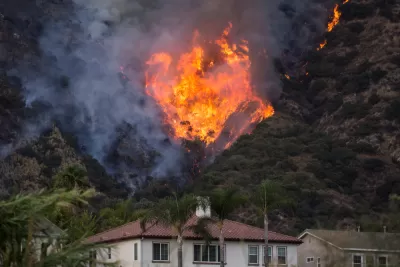
Los Angeles Times columnists Erika D. Smith and Anita Chabria write that California shouldn’t expect home insurers to stick around if the state continues to build in unsafe areas at constant risk for wildfires and extreme weather events.
“Our most vulnerable communities often lie in our most vulnerable regions: mountains marred by years of unprecedented wildfires, or Central Valley farm fields drowned in record rains and now epic snowmelt,” according to the column. The wake up call needed to reverse decades of sprawling development patterns, according to Smith and Chabria, might come from the home insurance industry.
According to previous coverage in the Los Angeles Times, State Farm General Insurance Co. announced recently that it would no longer accept new applications for property and casualty coverage in California because of wildfire and construction costs. Allstate Corp. also recently informed the state Department of Insurance that it stopped selling new home insurance policies last year. Allstate is also seeking a nearly 40% rate increase for home and business property and casualty insurance, according to the article.
Planetizen also picked up the news about insurers “fleeing” California, but it should be noted that insurers are also leaving Florida, where insurance premiums are already much higher than in California—and other states facing climate risks along coastlines or at wildland-urban interfaces shouldn’t expect to be spared the same drama forever.
According to the source article, linked below, California is still at risk of doubling down on sprawl, following years of historic housing legislation intended to spur new residential development.
“The problem is Newsom and his administration have required little oversight of where all this housing is being built. Nor have they communicated a cohesive philosophy about mitigating the current and future development risks linked to climate change,” write Smith and Chabria.
FULL STORY: Column: State Farm is right. California can’t keep building housing in high-risk places

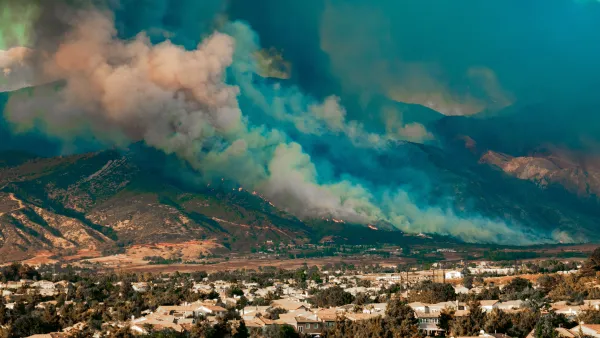
Home Insurers Are Fleeing California
Homeowners in the state are finding it increasingly difficult to secure insurance policies thanks to the growing risks of wildfire, drought, and other climate threats.

Over a Quarter of US Homes Face ‘Severe or Extreme’ Climate Risk
The number of U.S. homes at risk from hurricanes, fires, or flooding is valued at close to $13 trillion.
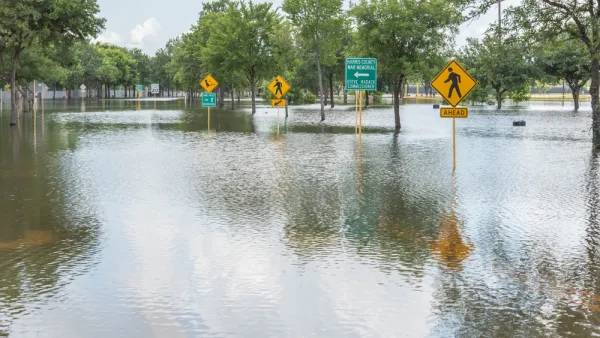
Houston Flooding: Climate Change or Development Patterns to Blame?
The Guardian's former environmental editor asks if urban sprawl is as much to blame as climate change for the flooding caused by Hurricane Harvey in Houston.

Planetizen Federal Action Tracker
A weekly monitor of how Trump’s orders and actions are impacting planners and planning in America.

The state-sanctioned urbicide of Austin
People don’t kill cities. Freeways do.

US to reduce Colorado River water deliveries to Mexico
A new Colorado Treaty amendment reduces Mexico’s Colorado River water allocation by 250,000 acre feet.

Mamdani overhauls NYC's Vision Zero plan with 100 new policy goals
The overhaul aims to reduce traffic deaths and make streets safer for pedestrians, cyclists and drivers through lower speed limits, new safety infrastructure and more.

Amtrak not solely to blame for New Jersey commuter rail's unreliability, report finds
A new study from the Garden State Initiative found that NJ Transit’s budget grew 20% across a 4 year period, but reliability declined significantly over the same period.

EPA erases limits on planet-warming pollution from power plants
Under Monday’s plan, power plants would still have some limits on how much mercury, arsenic and other contaminants they can emit.

FREE Course: Walkable City 1: Why Walkability?
After describing his path towards focusing on walkability as the essence of good planning, Jeff Speck marches through his five principal reasons for making more walkable places.
Reinventing Malls: Planning Alchemy—Turning Gray Fields Into Gold
The course focuses on the opportunities and imperatives that shape reinvention of mall sites.

Eagle County Government
Harvard University Graduate School of Design
Nashville Planning Department
The Architects Foundation
University of Cincinnati Online
The Pocatello Development Authority
The Urban Renewal Agency of the City of Pocatello
Journal of the American Planning Association