The North Houston Highway Improvement Project, stalled by a federal investigation, will now go ahead with only a few tweaks that opponents say don’t go far enough to mitigate the damage it will cause to Houston neighborhoods.


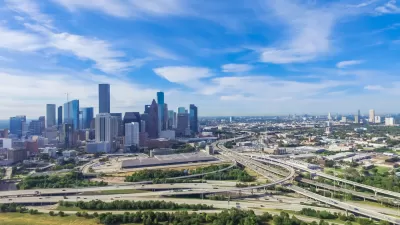
Another day, another twist in Houston’s infamous Interstate 45 expansion saga. As Kea Wilson explains in Streetsblog, “Last week, the Texas Department of Transportation announced that it had reached an agreement with the Federal Highway Administration to resume work on the $9-billion North Houston Highway Improvement Project, which will rebuild and expand the aging Interstate 45 and other highways throughout the Bayou City’s downtown core — and displace over a thousand residents and more than 300 businesses in predominantly BIPOC communities.”
Critics of the project are skeptical of the agency’s pledge to “evaluate the possibility of reducing the highway’s footprint where “reasonable” — which some advocates say means it’s unlikely to be reduced at all” and provide an ‘unspecified’ amount of funding for parks, bike facilities, and other local improvements.
Despite some grandstanding on the part of federal officials about the need to reevaluate our transportation system and road construction projects with equity in mind, Wilson writes that “Buttigieg and his colleagues don’t really have much of a say in whether bad highway projects go forward — because under the Infrastructure Investment and Jobs Act, Congress guaranteed states the right to build pretty much whatever they want with the bill’s $110 billion in funding.” Steve Davis, associated vice president for transportation strategy at Transportation for America, says “Until something fundamentally changes with the program, highway expansions are going to continue to happen.” USDOT has the authority to require a calculation of induced demand, eliminate “value of time” metrics, and other ‘nudges’ toward more sustainable policies, but more changes at the state and federal levels are required to shift away from the highway expansion status quo.
FULL STORY: ‘Secretary Pete Can’t Save You’: FHWA OKs Houston Highway Expansion After Pause

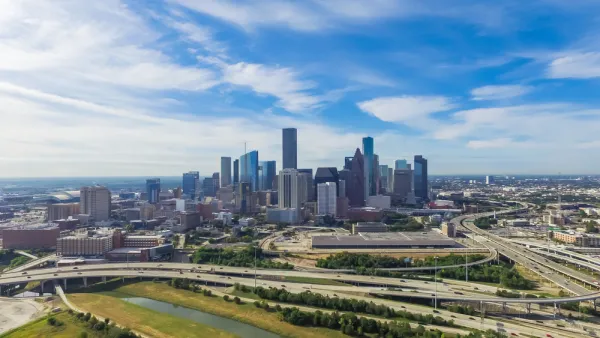
Details for Houston Interstate Project Remain Hazy
With the project still under federal investigation, local and state agencies say they are moving forward with the development of design details for the contentious freeway redesign.
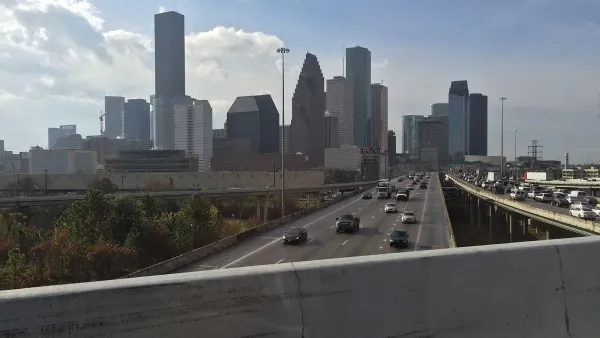
Contentious Houston Freeway Widening Project Inches Forward
Federal officials have given TxDOT the go-ahead to resume work on a small portion of a controversial interstate widening project in downtown Houston.
Fifth Ward Residents Oppose Houston's Interstate Expansion
The downtown freeway expansion will displace thousands of housed and unhoused residents and hundreds of small businesses.

Planetizen Federal Action Tracker
A weekly monitor of how Trump’s orders and actions are impacting planners and planning in America.

The state-sanctioned urbicide of Austin
People don’t kill cities. Freeways do.

US to reduce Colorado River water deliveries to Mexico
A new Colorado Treaty amendment reduces Mexico’s Colorado River water allocation by 250,000 acre feet.

5 New England states march closer to 800 megawatt wind energy project
Securing federal approval for the project may be complicated under the Trump administration, which has historically been hostile towards domestic wind power.

Baltimore to break ground on $50 million Transit Priority Project
The project will bring faster bus trips, safer streets and better bike connections to Baltimore.

Airbnb launches $250 million 'last-dollar financing' housing accelerator, makes first investment in Austin
The company will put $6.4 million towards affordable housing development in Texas’ capital.

FREE Course: Walkable City 1: Why Walkability?
After describing his path towards focusing on walkability as the essence of good planning, Jeff Speck marches through his five principal reasons for making more walkable places.
Reinventing Malls: Planning Alchemy—Turning Gray Fields Into Gold
The course focuses on the opportunities and imperatives that shape reinvention of mall sites.

Eagle County Government
Harvard University Graduate School of Design
Nashville Planning Department
The Architects Foundation
University of Cincinnati Online
The Pocatello Development Authority
The Urban Renewal Agency of the City of Pocatello
Journal of the American Planning Association