For many low-income households, bikes offer an affordable way to access more destinations and economic opportunities.


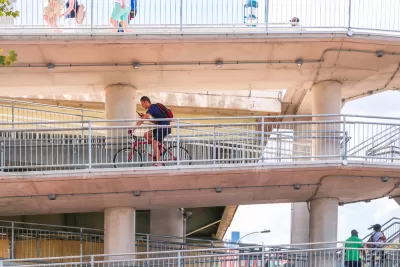
In a highly personal piece in The Philadelphia Inquirer, high school senior Sarahi Franco-Morales describes how bicycles have been a lifeline for their family, and even contributed to their acceptance into the University of Pennsylvania. “The bicycle made traveling and connecting with people all over Philadelphia accessible,” Franco-Morales writes. “That’s how I found myself on Penn’s campus during a tour last October, sitting next to Ben on the Bench, daring to dream about my future.”
For Franco-Morales and her parents, biking is a crucial transportation mode. “We ride year-round, even in the 100-degree summer heat, the sweat stinging our eyes. We ride our bikes in the rain and snow, dodging the spray of gray slush from passing cars and buses. Each time, we hope we come back alive, not another number in the growing toll of bike riders killed on our city streets.” Growing up with bikes at the center of their life, Franco-Morales learned more about the city. “Biking opened my eyes to the disparities across Philadelphia. It pushed me to strive for a future where owning a car was economically viable for us.”
This story highlights the vital importance of safe and widespread bike infrastructure, reminding the reader that bike riding isn’t just for kids or recreation. For many of the nation’s lowest-income workers, bicycles provide an essential and affordable mode of travel.
Read the full story: For my low-income family, biking is not recreation. ‘It’s survival.’
2025's 30 Most Bike-friendly Cities
Copenhagenize has released its list of top cities for cyclists. Spoiler alert: the United States doesn’t make the list.

Centering Bikes in the Future of Mobility
Those in search of high-tech solutions for urban congestion and pollution often overlook the bicycle as a powerful, if simple, tool for reducing both and improving urban transportation.
How Boosting Biking Could Improve London's Economy
A new study outlines the potential economic, environmental, and public health benefits of increasing cycling mode share in London, which has pledged to achieve net-zero emissions by 2030.

Planetizen Federal Action Tracker
A weekly monitor of how Trump’s orders and actions are impacting planners and planning in America.

California plans to bury El Niño’s downpour
If the state plays its cards right, it may be able to store a billion acre-feet of El Niño’s water in aquifers.

Desperate measures: Advocates weigh draining Lake Powell to fill Colorado River
Draining the reservoir could reduce evaporation losses by a couple hundred thousand acre-feet.

In Texas, data centers are swallowing promised parkland
Residents who moved to Taylor, Texas for a rural community now have to contend with three data centers in their backyard.

How a Chicago-sized wind farm beat the odds and powered on
The project spanned five presidential administrations and a standoff with a U.S. military base.

MTA gives itself 30 days to transform pit into basketball court
The site has been under construction since 2022; the city originally estimated it would finish the court in 2024.

FREE Course: Walkable City 1: Why Walkability?
After describing his path towards focusing on walkability as the essence of good planning, Jeff Speck marches through his five principal reasons for making more walkable places.
Reinventing Malls: Planning Alchemy—Turning Gray Fields Into Gold
The course focuses on the opportunities and imperatives that shape reinvention of mall sites.

City of Rosemead
Rutgers University, Edward J. Bloustein School of Planning and Public Policy
One Hundred Miles
Hunter College, City University of New York (CUNY)
The Architects Foundation
University of Cincinnati Online
City of Cambridge
Montrose County
The Pocatello Development Authority