Local governments often come to different conclusions about how to address homelessness within their respective borders, but varying approaches only exacerbate the problem.


In mid-December, Karen Bass was sworn in as mayor in Los Angeles, the first woman mayor in city history. Leaders across the region were quick to express support when Bass declared a state of emergency related to homelessness and launched the Inside Safe program, with the intention of moving people off the street and into temporary housing in city-leased properties. These actions, taken during the new mayor’s first week in office, signaled her intention to ensure a path to housing the unhoused.
In Los Angeles County, nearly 70,000 people experience homelessness. Bass’s office will have to contend with structural and jurisdictional peculiarities that limit her reach in a region that is notoriously difficult to govern. One such peculiarity is the makeup of a place that is often referred to collectively as “Los Angeles,” but is actually a mashup of smaller cities with their own governing bodies.
The City of Los Angeles is the largest municipality in Los Angeles County, but it encompasses less than 4 million of the region’s nearly 10 million residents. The rest live in cities like Santa Monica, Beverly Hills, and Culver City, all of which have their own mayors and city councils that govern independently.
For Bass and her stated goals, this presents an imposing obstacle. Houselessness is a regional issue and, despite wide recognition of the challenges associated with truly addressing the problem, local governments tend to work in silos and arrive at very different conclusions about how to address homelessness within their respective borders. This problem is illustrated by the story of one long-standing encampment that straddles the border between the City of L.A. and Culver City.
An Underpass in the Middle
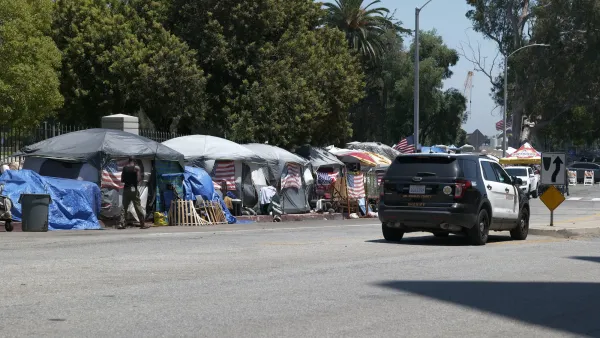
The people who live under the 405 Freeway underpass on Venice Boulevard have faced a lot of scrutiny from the surrounding housed community. In 2020 and 2021, a series of tent fires and violent crimes thrust the encampment into the spotlight. Local news coverage focused on issues of safety and cleanliness in the neighborhood, with one article going so far as to be titled “A window into the nightmare of living next to the 405 underpass.” Public discourse focused on clearing the encampments, with debate centering on services for folks who are displaced versus enforcement. Yet the reality of this particular situation has proven much more complex than whether to force residents to relocate or not.
This encampment, one of the largest on L.A.’s Westside, is ....
Continue reading at the link below.
Read the full story: Bordering Towns in LA County Clash Over Their Homeless Policies

Study: LA’s Homelessness Program Displaced 5 People for Every One it Helped
Researchers say a city program designed to help people access housing and services “does not live up to its name” and has caused more harm than good.
LA Proposal Would Forcibly Remove Unhoused People Near Olympic Venues
Los Angeles County sent city officials a report outlining strategies for clearing homeless encampments, but advocates point out that the report itself notes there are not enough shelte resources to accommodate all unhoused residents.

LA Housing Authority Buys 30-Unit Apartment Building for Supportive Housing
The Koreatown building will offer housing as well as healthcare services and case management.

Planetizen Federal Action Tracker
A weekly monitor of how Trump’s orders and actions are impacting planners and planning in America.

California plans to bury El Niño’s downpour
If the state plays its cards right, it may be able to store a billion acre-feet of El Niño’s water in aquifers.

Desperate measures: Advocates weigh draining Lake Powell to fill Colorado River
Draining the reservoir could reduce evaporation losses by a couple hundred thousand acre-feet.

Chicago Avenue bridge construction delays enrages city leaders
The bridge has been closed since 2025. The city originally aimed to re-open it in December, and now expects to finish construction in 2027.

NYC bus network redesign speeds up Queens buses
Rush routes have seen a 4.6% speed increase after the redesign.

California High-Speed Rail Authority picks trainset manufacturer
The California High-Speed Rail Authority aims to start servicing passengers by 2033.

FREE Course: Walkable City 1: Why Walkability?
After describing his path towards focusing on walkability as the essence of good planning, Jeff Speck marches through his five principal reasons for making more walkable places.
Reinventing Malls: Planning Alchemy—Turning Gray Fields Into Gold
The course focuses on the opportunities and imperatives that shape reinvention of mall sites.

City of Rosemead
Rutgers University, Edward J. Bloustein School of Planning and Public Policy
One Hundred Miles
Hunter College, City University of New York (CUNY)
The Architects Foundation
University of Cincinnati Online
City of Cambridge
Montrose County
The Pocatello Development Authority