The shortage of housing at all price points in the region is the main driver of high costs and the growing homelessness crisis.



In an op-ed in the Los Angeles Times, Michael Lens explains why building more housing, including market rate housing, is the best way to improve affordability and keep people from falling into homelessness.
“Despite investments in supportive housing and services, the number of Angelenos who struggle to stay housed has remained unacceptably high. Further, Black Angelenos are nearly seven times as likely to experience homelessness as the rest of L.A. County,” Lens writes.
To address the crisis, newly elected mayor Karen Bass has declared a state of emergency. “The declaration gives her power to convert hotel rooms into housing, sign master leases for entire buildings and expedite housing approvals. She is determined to see more temporary shelters and subsidized housing be built.”
But as Lens explains, “Moving people into temporary quarters might seem like the only quick solution, but any approach that relies on shelters runs counter to the research evidence that permanent housing solutions are both less costly and more effective.” In fact, “Getting people off the street makes only a small dent in the problem if those people are replaced by new distressed renters.” A bigger problem is the housing shortage in the region. Once zoned for 10 million housing units, the city is now zoned for only 4 million, not keeping up with its growing population.
Despite gentrification and displacement concerns, “Allowing more and faster production of market-rate housing can slow the pace at which rent rises and make our housing subsidy dollars go further.” Lens argues that “If we build new housing, the neighborhood will still change, but incoming renters have somewhere to go that’s not already occupied.”
Considering that building subsidized housing for all who need it is likely an unrealistic goal, Lens writes, promoting more housing construction of all types is the next best solution to the housing crisis.
Read the full story: Op-Ed: How do we keep L.A.'s housing costs affordable? Build more homes

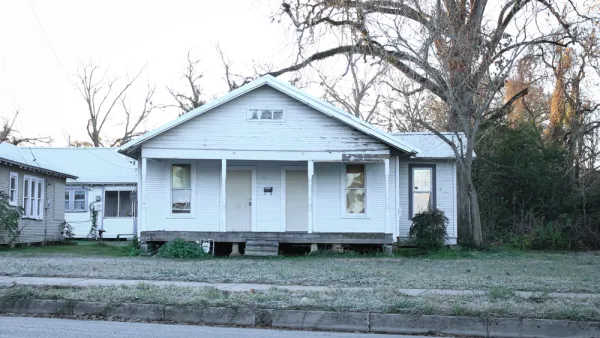
The Quiet Housing Crisis in Rural America
While housing shortages in major cities are grabbing headlines, rural communities are seeing higher rates of growth in housing prices and a silently spreading homelessness crisis.

Dallas Housing Nonprofit Warns of Dwindling Resources
A nonprofit that works to house people experiencing homelessness is calling on more landlords to participate in programs that match housing voucher recipients with available units.

California Governor to Cities: Homelessness is a Crisis. “Act Like it.”
Days before facing reelection, Governor Newsom rejected every California locality’s plan for addressing homelessness, calling the proposals inadequate in fighting the massive crisis in a state where over 100,000 people are unhoused.

Planetizen Federal Action Tracker
A weekly monitor of how Trump’s orders and actions are impacting planners and planning in America.

California plans to bury El Niño’s downpour
If the state plays its cards right, it may be able to store a billion acre-feet of El Niño’s water in aquifers.

Chicago breaks ground on $3 billion megadevelopment
The new neighborhood, titled Foundry Park, will one day host 3,700 residences.

California High-Speed Rail Authority CEO resigns after $600,000 scandal
Under Ian Choudri, the authority used taxpayer dollars to fund first class flights and trips to nightclubs.

Want to study the Missouri River? Soon, you may need unanimous approval from 10 states
Legislation would require 10 governors’ permission to study or build projects moving water outside the basin.

Desperate measures: Advocates weigh draining Lake Powell to fill Colorado River
Draining the reservoir could reduce evaporation losses by a couple hundred thousand acre-feet.

FREE Course: Walkable City 1: Why Walkability?
After describing his path towards focusing on walkability as the essence of good planning, Jeff Speck marches through his five principal reasons for making more walkable places.
Reinventing Malls: Planning Alchemy—Turning Gray Fields Into Gold
The course focuses on the opportunities and imperatives that shape reinvention of mall sites.

City of Rosemead
Rutgers University, Edward J. Bloustein School of Planning and Public Policy
One Hundred Miles
Hunter College, City University of New York (CUNY)
The Architects Foundation
University of Cincinnati Online
City of Cambridge
Montrose County
The Pocatello Development Authority