Cities in Santa Cruz County, California are making outdoor dining laws permanent, and some businesses are getting sticker shock at the extra cost of maintaining the pandemic-era expansion of al fresco dining.


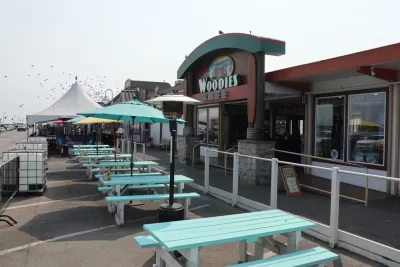
Jurisdictions in Santa Cruz County are in the process of overhauling the temporary, emergency outdoor dining rules put in place during the pandemic, according to an article by Thomas Sawano for Lookout Santa Cruz, with the purpose of making parklets permanently safe and economically feasible.
According to a Lookout estimate, 81 Santa Cruz County businesses are operating parklets for outdoor dining spaces in former street parking spaces—not even counting the “large number of businesses with dining spaces in their private parking lots.”
Some cities in the county, however, are busy crafting new regulations for the parklets, adding costs and uncertainty about the ability of businesses to continue operating the spaces. Sawano provides more detail:
Capitola’s city council passed a permanent outdoor dining ordinance in December 2021 that limited the number of parking spaces businesses could use for dining space to 25 and introduced new design requirements and guidelines for semi-permanent street dining setups. In Santa Cruz, an ordinance establishing a permanent parklet program passed its first reading before its city council on Oct. 25. It is slated for final review Tuesday.
The changes will cost “big bucks” in some cases, according to sources cited by Sawano in the article below.
Read the full story: Santa Cruz County’s parklets are here to stay. What will they look like now?
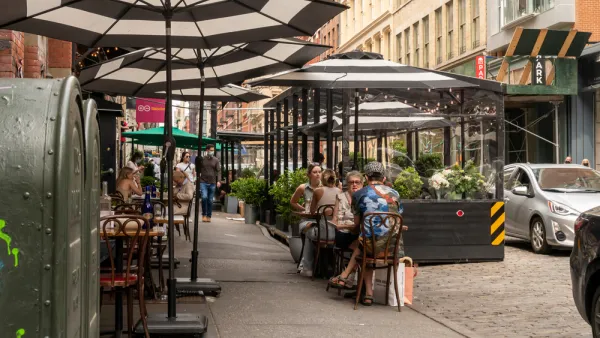
The Slow Retreat of Pandemic-Era Outdoor Dining Programs Continues
It’s been almost three years since the political dynamics of outdoor dining in the United States shifted, suddenly and overwhelmingly. Increasingly, the status quo is being restored.

Open Streets and Outdoor Dining Are Best for Business, Report Says
Most business owners believe that they'd be out of business without on-street parking near their front door. The experience of New York City during the pandemic proves otherwise.
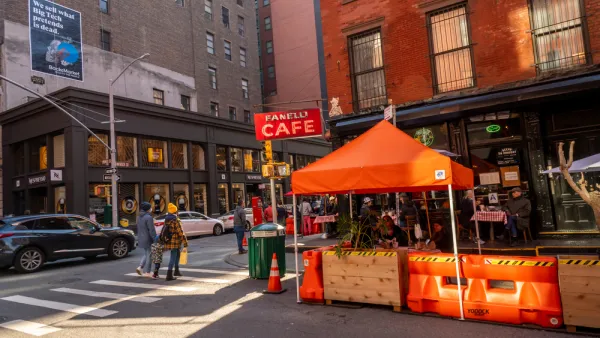
Opinion: Keep Outdoor Dining Without Thwarting Creativity
While New York City's effort to make its outdoor dining program permanent is a welcome reimagining of public space, some worry that regulations will reduce design diversity and increase costs for small restauranteurs.

Planetizen Federal Action Tracker
A weekly monitor of how Trump’s orders and actions are impacting planners and planning in America.

California plans to bury El Niño’s downpour
If the state plays its cards right, it may be able to store a billion acre-feet of El Niño’s water in aquifers.

Desperate measures: Advocates weigh draining Lake Powell to fill Colorado River
Draining the reservoir could reduce evaporation losses by a couple hundred thousand acre-feet.

US buildings threatened, destroyed by fires set to triple by 2060
Researchers found a high fire risk for socioeconomically vulnerable neighborhoods in the American West.

LA residents may be allowed to paint their own crosswalks
Councilwoman Katy Yaroslavsky put out a motion instructing the Los Angeles Department of Public Transportation to study the feasibility of allowing volunteers to paint crosswalks.

Dallas moves to overhaul its zoning code
The city's zoning reform will allow more multi-family and mixed-use developments.

FREE Course: Walkable City 1: Why Walkability?
After describing his path towards focusing on walkability as the essence of good planning, Jeff Speck marches through his five principal reasons for making more walkable places.
Reinventing Malls: Planning Alchemy—Turning Gray Fields Into Gold
The course focuses on the opportunities and imperatives that shape reinvention of mall sites.

City of Rosemead
Rutgers University, Edward J. Bloustein School of Planning and Public Policy
One Hundred Miles
Hunter College, City University of New York (CUNY)
The Architects Foundation
University of Cincinnati Online
City of Cambridge
Montrose County
The Pocatello Development Authority