More cities and states are recognizing the harmful impacts of minimum parking requirements, which in many cases have accelerated sprawl and raised the cost of housing construction.


California’s recent decision to eliminate parking requirements at developments near public transit could have a major impact on the country’s parking lot ‘addiction,’ writes Ciara Nugent in Time. “The move will encourage developers to build more affordable homes for people who don’t want a parking space, and generate ‘more walkable neighborhoods and public transit,’ [California Governor] Newsom said.”
According to Nugent, “The shift is heartening for climate advocates who believe redesigning cities and how people move around them must be a critical part of the country’s efforts to reduce its outsize greenhouse gas emissions from cars.” The law doesn’t bar developers from building as much parking as demand calls for, but prevents cities from maintaining often exaggerated requirements that drive up building costs.
The article details the history of minimum parking requirements, which began as a reaction to the sudden influx of automobiles to cities as the invention became more affordable. “As more people bought cars, a self-fulfilling cycle set in: cities started to separate districts by use, assuming everyone can drive from their residential area to their shopping area to their office. Large highways began to cut through town centers, making it harder to cycle or walk.”
Today, the tide is slowly turning against parking as cities and states eliminate parking minimums, invest in public transit and other multimodal infrastructure, and encourage developers to build denser, more transit-oriented development that reduces the American overreliance on cars.
FULL STORY: Americans' Addiction to Parking Lots Is Bad for the Climate. California Wants to End It

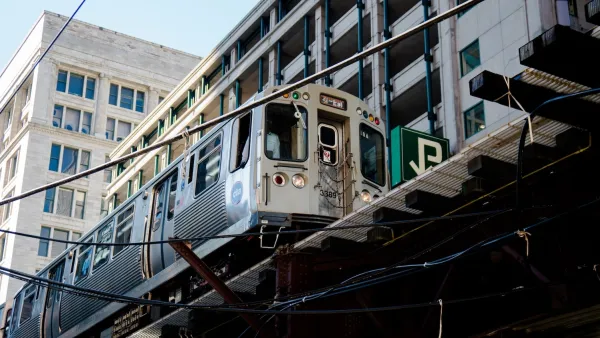
Illinois ‘People Over Parking Act’ Bans Parking Requirements Near Transit
The new law could unlock denser, more affordable housing development near train and bus lines.

Utah Could Eliminate Parking Requirements Near Transit
A proposed state bill would bar cities from requiring parking in areas adjacent to transit stations in an effort to make housing production more affordable and encourage walking and transit use.

Miami’s Return to Parking Minimums a Mystery to Housing Advocates
The city’s decision to reinstate parking requirements for housing developments will likely slow the recent boom of ‘missing middle housing’ construction.

Planetizen Federal Action Tracker
A weekly monitor of how Trump’s orders and actions are impacting planners and planning in America.

The state-sanctioned urbicide of Austin
People don’t kill cities. Freeways do.

US to reduce Colorado River water deliveries to Mexico
A new Colorado Treaty amendment reduces Mexico’s Colorado River water allocation by 250,000 acre feet.

5 New England states march closer to 800 megawatt wind energy project
Securing federal approval for the project may be complicated under the Trump administration, which has historically been hostile towards domestic wind power.

Baltimore to break ground on $50 million Transit Priority Project
The project will bring faster bus trips, safer streets and better bike connections to Baltimore.

Airbnb launches $250 million 'last-dollar financing' housing accelerator, makes first investment in Austin
The company will put $6.4 million towards affordable housing development in Texas’ capital.

FREE Course: Walkable City 1: Why Walkability?
After describing his path towards focusing on walkability as the essence of good planning, Jeff Speck marches through his five principal reasons for making more walkable places.
Reinventing Malls: Planning Alchemy—Turning Gray Fields Into Gold
The course focuses on the opportunities and imperatives that shape reinvention of mall sites.

Eagle County Government
Harvard University Graduate School of Design
Nashville Planning Department
The Architects Foundation
University of Cincinnati Online
The Pocatello Development Authority
The Urban Renewal Agency of the City of Pocatello
Journal of the American Planning Association