Another day, another historic planning-related bill signed into law in the Golden State.


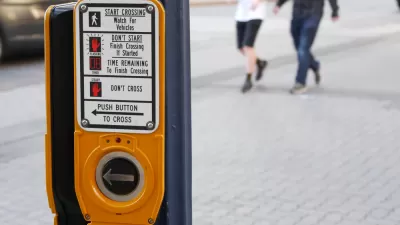
In 2021, California Governor Gavin Newsom vetoed a bill, AB 1238, that would have decriminalized jaywalking in the state, in a major setback for the cause of making streets safer for noon-vehicular modes of transportation.
In 2022, Gov. Newsom signed a similar bill—AB 2147, also known as “The Freedom to Walk Act,” authored by the same state legislator, Assembly Member Phil Ting (D-San Francisco). The law takes effect of January 1, 2023.
Colleenn Shalby reports on the new law for the Los Angeles Times:
Under the new law, pedestrians would be able to legally cross the street outside of designated intersections without the threat of a hefty citation “unless a reasonably careful person would realize there is an immediate danger of collision with a moving vehicle or other device moving exclusively by human power.”
Shalby notes that jaywalking laws grew out of auto industry lobbying in the early 20th century—one of the most obvious signs of the growing car-centric planning and automobile dependence that continues to dominate the American built environment.
Data shows that jaywalking laws in the 21st century have disparate impacts for low-income individuals and people of color. “Data cited by Ting’s office from the California Racial and Identity Profiling Act shows that Black Californians are up to 4.5 times more likely to be stopped for jaywalking than those who are white,” writes Shaby.
The governor’s signature on AB 2147 follows shortly after the ink dried on two other historically significant planning reforms: AB 2097, which remove parking requirements near transit stops, and AB 2011, which made affordable housing developments on commercially zoned properties legal by right.
FULL STORY: Jaywalking is decriminalized in California under new law

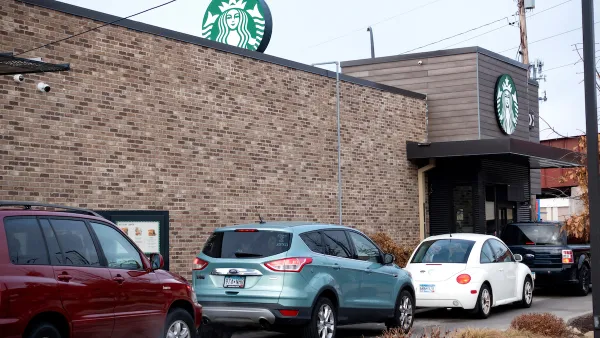
More Cities Ponder the End of Drive-Thrus
Drive-thru fast food restaurants might be a staple of American life, but several U.S. cities are actively considering prohibiting the development of new drive-thrus for the benefit of traffic safety, air quality, and congestion.

Europe Building a Post-Car Future
While the United States mobilizes to transition to electric cars, cities and countries in Europe are transitioning to fewer cars.
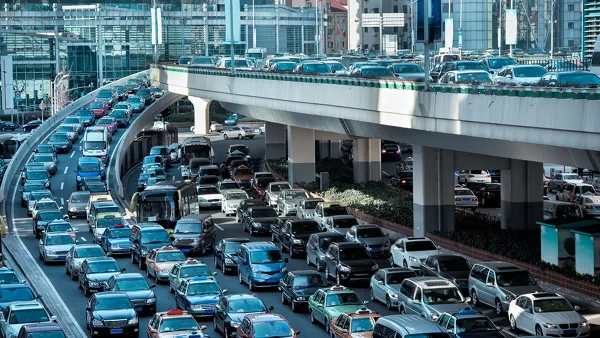
The Disparate Racial Impacts of Commute Times
Commute times vary significantly depending on race, according to a recent study. The consequences of the imbalance have very real social and economic effects for already marginalized racial groups.

Planetizen Federal Action Tracker
A weekly monitor of how Trump’s orders and actions are impacting planners and planning in America.

The state-sanctioned urbicide of Austin
People don’t kill cities. Freeways do.

US to reduce Colorado River water deliveries to Mexico
A new Colorado Treaty amendment reduces Mexico’s Colorado River water allocation by 250,000 acre feet.

5 New England states march closer to 800 megawatt wind energy project
Securing federal approval for the project may be complicated under the Trump administration, which has historically been hostile towards domestic wind power.

Baltimore to break ground on $50 million Transit Priority Project
The project will bring faster bus trips, safer streets and better bike connections to Baltimore.

Airbnb launches $250 million 'last-dollar financing' housing accelerator, makes first investment in Austin
The company will put $6.4 million towards affordable housing development in Texas’ capital.

FREE Course: Walkable City 1: Why Walkability?
After describing his path towards focusing on walkability as the essence of good planning, Jeff Speck marches through his five principal reasons for making more walkable places.
Reinventing Malls: Planning Alchemy—Turning Gray Fields Into Gold
The course focuses on the opportunities and imperatives that shape reinvention of mall sites.

Eagle County Government
Harvard University Graduate School of Design
Nashville Planning Department
The Architects Foundation
University of Cincinnati Online
The Pocatello Development Authority
The Urban Renewal Agency of the City of Pocatello
Journal of the American Planning Association