A record 66 developers applied to refurbish 150 vacant, city-owned homes.



“Milwaukee’s $15 million proposal to renovate 150 vacant, city-owned homes is moving forward,” reports Jeramey Jannene in Urban Milwaukee. “The city will sell the houses for as little as $1, provide a development subsidy estimated at $75,000 based on the renovation cost estimates and grant a $5,000 workforce subsidy. After renovation, the properties may be sold to owner-occupants, rented out or placed into a rent-to-own program.”
The city selected 14 non-profit and for-profit operators from a record 66 applicants that responded to its Request for Proposals (RFP) to rehabilitate the homes. “The program is designed to create affordable housing, expand the city’s tax base and create jobs.” The plan was scaled down from a proposal to rehab all 700 city-owned homes. According to the article, “The program is focused on vacant houses. Tenants in a house at the time of foreclosure are allowed to continue living there with DCD assuming the role of landlord.”
The program prevents developers from ‘flipping’ properties to another owner (except an owner-occupant). “A deed restriction will require a sold property to be owner-occupied for five years and owners would be required to complete eight hours of home-buyer counseling through either Acts Housing, Housing Resources, Inc. or the United Community Center.”
Read the full story: 66 Developers Bid To Rehab City’s Vacant Homes

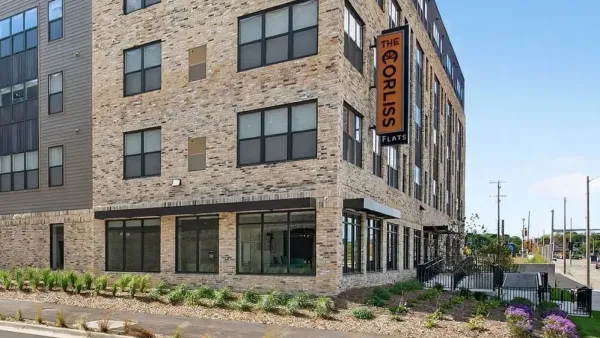
The complex web of funding behind Wisconsin's largest private affordable housing complex
The 576-unit project offers lessons for other large-scale affordable housing projects.

Oklahoma has Over 200,000 Vacant Homes. None are Affordable to Low-income Families.
The state faces a shortage of over 80,000 rental units for extremely low-income households while hundreds of thousands of vacant units face financial or legal barriers to restoration.
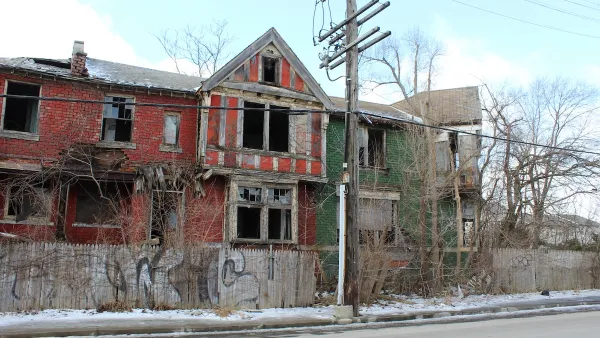
Checking in on Detroit’s Housing Renaissance
Efforts by the city and residents have generated 17,000 new housing units in the last five years.

Planetizen Federal Action Tracker
A weekly monitor of how Trump’s orders and actions are impacting planners and planning in America.

California plans to bury El Niño’s downpour
If the state plays its cards right, it may be able to store a billion acre-feet of El Niño’s water in aquifers.

Chicago breaks ground on $3 billion megadevelopment
The new neighborhood, titled Foundry Park, will one day host 3,700 residences.

California High-Speed Rail Authority CEO resigns after $600,000 scandal
Under Ian Choudri, the authority used taxpayer dollars to fund first class flights and trips to nightclubs.

Want to study the Missouri River? Soon, you may need unanimous approval from 10 states
Legislation would require 10 governors’ permission to study or build projects moving water outside the basin.

Desperate measures: Advocates weigh draining Lake Powell to fill Colorado River
Draining the reservoir could reduce evaporation losses by a couple hundred thousand acre-feet.

FREE Course: Walkable City 1: Why Walkability?
After describing his path towards focusing on walkability as the essence of good planning, Jeff Speck marches through his five principal reasons for making more walkable places.
Reinventing Malls: Planning Alchemy—Turning Gray Fields Into Gold
The course focuses on the opportunities and imperatives that shape reinvention of mall sites.

City of Rosemead
Rutgers University, Edward J. Bloustein School of Planning and Public Policy
One Hundred Miles
Hunter College, City University of New York (CUNY)
The Architects Foundation
University of Cincinnati Online
City of Cambridge
Montrose County
The Pocatello Development Authority