Checking in with The Hub, a proposed rezoning that would enable a multi-parcel redevelopment at a conspicuous intersection, two years after the city paused the rezoning for additional analysis (spoiler alert: the analysis hasn’t even started).


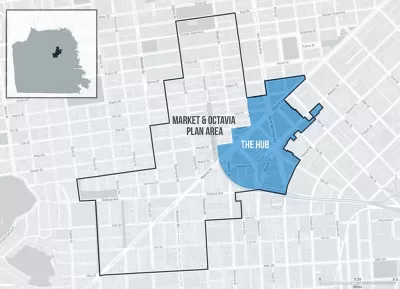
San Francisco Chronicle Columnist Heather Knight [paywall] provides an update on the planning for a controversial redevelopment project known as “The Hub,” located on a collection of parcels at the intersection of two of San Francisco’s most prominent streets—Van Ness and Market.
“Planning officials have long wanted to rezone the area, dubbed the Hub, to allow taller, denser apartment buildings in an area well-suited for them and in a city that famously needs them. The housing would be near transit, and the projects would create union jobs while not displacing any residents,” explains Knight.
Back in July, the San Francisco Board of Supervisors decided to pause the plan to perform a race ad equity analysis for the project, part of a deal that allowed three nearby projects to move forward. According to Knight’s account of the episode, Supervisor Dean Preston, a popular target for California YIMBYs, pushed for the analysis. “Preston said the city should get input from the nearby Western Addition neighborhood, where Black residents have notoriously been pushed aside by land development,” writes Knight.
Racial impact and equity analyses are becoming a more popular, common planning tool, implemented in various forms in New York City, Seattle, and Northeast Ohio, for example. In San Francisco, it seems that the practice is mostly for show.
“TODCO, the powerful affordable housing organization run by John Elberling, was set to complete the study on its own dime,” reports Knight. “Two years and one month later, the study hasn’t begun. In fact, Elberling told me this week, he’s not going to do the study. He blamed a number of issues, including the pandemic — though the virus was in full swing when he agreed to conduct the study — and a consulting group that said it would help but didn’t.”
Meanwhile zero progress has been made on a project that would contribute significant numbers of housing to a city with a mandate to build 82,000 new units by 2031 through the state Regional Housing Needs Assessment process.
Planetizen also picked up news about the city's plans to rezone the site of The Hub in 2017.
Read the full story: The latest S.F. housing failure: Thousands of units delayed for a study that never happened

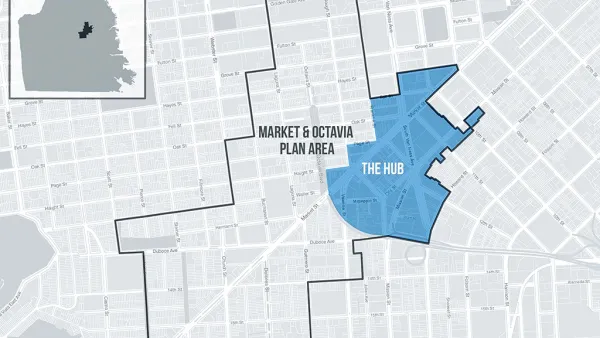
S.F. Rezoning Plan Paused for Equity Analysis
A plan to rezone parcels around the busy intersection of Market Street and Van Ness Avenue in San Francisco, called the Hub, will undergo an analysis of the potential impacts of the plan on marginalized communities.
Caltrain Railyard Redevelopment Back on the Table in San Francisco
An incredibly complex development proposal for 20 acres of Caltrain railyard is back on the table, nearly a decade since it first made news in San Francisco.
On Housing, Cities' Traditional Political Labels No Longer Apply
Historically liberal cities belie their supposed concern for human welfare by rejecting new development. Meanwhile, more conservative cities have seized the moment to become more progressive, innovative, and inclusive.

Planetizen Federal Action Tracker
A weekly monitor of how Trump’s orders and actions are impacting planners and planning in America.

California plans to bury El Niño’s downpour
If the state plays its cards right, it may be able to store a billion acre-feet of El Niño’s water in aquifers.

Chicago breaks ground on $3 billion megadevelopment
The new neighborhood, titled Foundry Park, will one day host 3,700 residences.

Satanic Place Names
From streams and lakes to valleys and canyons, I mapped more than 1,000 places named after the Devil.

California High-Speed Rail Authority CEO resigns after $600,000 scandal
Under Ian Choudri, the authority used taxpayer dollars to fund first class flights and trips to nightclubs.

Want to study the Missouri River? Soon, you may need unanimous approval from 10 states
Legislation would require 10 governors’ permission to study or build projects moving water outside the basin.

FREE Course: Walkable City 1: Why Walkability?
After describing his path towards focusing on walkability as the essence of good planning, Jeff Speck marches through his five principal reasons for making more walkable places.
Reinventing Malls: Planning Alchemy—Turning Gray Fields Into Gold
The course focuses on the opportunities and imperatives that shape reinvention of mall sites.

City of Rosemead
Rutgers University, Edward J. Bloustein School of Planning and Public Policy
One Hundred Miles
Hunter College, City University of New York (CUNY)
The Architects Foundation
University of Cincinnati Online
City of Cambridge
Montrose County
The Pocatello Development Authority