A $1.1 billion donation to Stanford seeks to mitigate climate change. As impressive as that gesture is, the real solutions to climate change lie in hearts and minds around the world—and not in Palo Alto, California.



“I don’t doubt that an institution like Stanford will produce important work with those funds. And yet, the idea of fighting climate change by cloistering it in an ultra-exclusive institution, in a region that is already well versed in the ravages of climate chance, seems to miss the mark.”
“Dating back to the days of 'An Inconvenient Truth,' the state adopted a raft of laws and regulations designed to promote dense development. They include AB 32 (greenhouse gas reduction), SB 375, (dense development and coordination between land use and transportation), SB 743 (reducing vehicle miles traveled), and others—all of which take aim, in some way or another—at the carbon-intensive landscape that California built in the 20th century and on the types of fuels we use.”
“Despite having a darn good model of dense urbanism at the northern end of the San Francisco Peninsula, the cities of the South Bay exemplify what not to do. They rely on freeways and wide boulevards. They celebrate single-family homes and denigrate density. They price out almost all workers below executive level, forcing them to drive in or take infamous 'Google Buses' and the like. For people who deal in futuristic nano-scale technology, the carbon footprint of the typical Silicon Valleyite is more like that of a brontosaurus.”
Read the full story: An Ivory Tower Solution To Climate Change

White Roofs Don't Slow Global Warming, Says New Study
A recent study published by researchers at Stanford University shows how the heat island effect has little bearing on global warming and how painting roofs white actually may increase temperatures, writes David Malakoff for The Guardian.
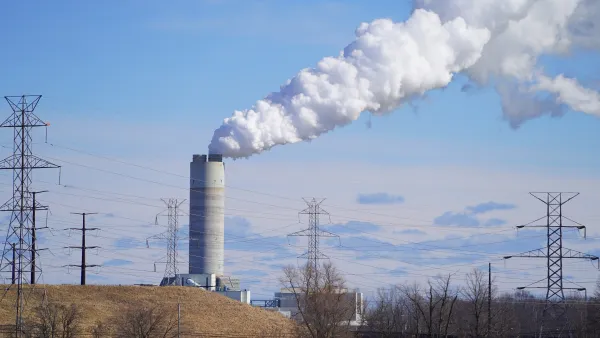
EPA erases limits on planet-warming pollution from power plants
Under Monday’s plan, power plants would still have some limits on how much mercury, arsenic and other contaminants they can emit.

Climate change is battering US water systems
The American Water Works Association estimates that roughly $2 trillion will be needed to update municipal water systems for contemporary conditions.

Planetizen Federal Action Tracker
A weekly monitor of how Trump’s orders and actions are impacting planners and planning in America.

Colorado’s Largest Data Center Could Rise Next to Homes — Without a Public Hearing
The proposed campus would consume 11 times the power of Denver International Airport; as it has across the country, opposition mounts.

US to reduce Colorado River water deliveries to Mexico
A new Colorado Treaty amendment reduces Mexico’s Colorado River water allocation by 250,000 acre feet.

'This is going to be painful:’ Virginia stares down $1.7 billion funding gap for highway maintenance
The state may address the deficit by shifting $290 million from its construction budget to maintenance projects.

Judges permit Denver to divert 77,000 acre feet from the Colorado River for reservoir expansion
Overuse and climate change have caused the Colorado River’s water levels to plummet.

Amtrak, CN end decades-long dispute with eight-year agreement
The new operating agreement establishes an updated framework for the companies to work together, including processes to resolve disputes.

FREE Course: Walkable City 1: Why Walkability?
After describing his path towards focusing on walkability as the essence of good planning, Jeff Speck marches through his five principal reasons for making more walkable places.
Reinventing Malls: Planning Alchemy—Turning Gray Fields Into Gold
The course focuses on the opportunities and imperatives that shape reinvention of mall sites.

KFH Group Inc.
Greater Baltimore Committee
Eagle County Government
The Architects Foundation
University of Cincinnati Online
The Pocatello Development Authority
The Urban Renewal Agency of the City of Pocatello