Empire State Redevelopment unanimously voted to support the planned redevelopment of Midtown Manhattan’s much-maligned Penn Station.


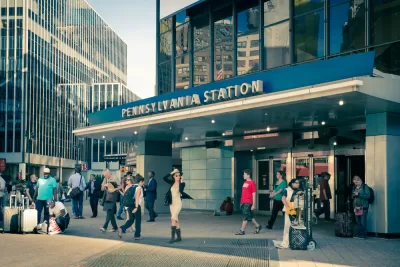
New York City’s economic development agency has approved a plan for the redevelopment of Penn Station and surrounding area, reports Kristine Klein in The Architect’s Newspaper. “Under the approved plan most of the new constructions in the so-called Empire Station Complex will be dedicated to commercial space, including offices and retail, spread across 10 skyscrapers to form an office-centric neighborhood on par with nearby Hudson Yards. The plan also includes 1,800 housing units, a hotel, and a long-overdue renovation to Penn Station, recently dubbed a ‘hellhole’ by [New York governor Kathy] Hochul.”
“The proposed reconstruction of Penn Station will include cosmetic upgrades, the reconfiguration of the train hall serving NJ Transit and Long Island Rail Road, subway improvements, and the construction of a rail tunnel under the Hudson River, all estimated to cost $7 billion, with the surrounding redevelopment proposal increasing the cost another $13 billion.” The project will connect to the new Moynihan Train Hall.
According to the article, “With the ESD’s approval an application can now be made for federal funding to assist with the costs of the project’s development. However, who will dish out the money for the megaproject is still not confirmed.” Neither is a design: “The ESD has not released a Request for Proposals (RFP) for the larger design scheme; last month the State formally commenced an RFP seeking architecture and engineering firms to execute the outlined design work at Penn Station.”
After a design is finalized, the project will need to be approved by the Public Authorities Control Board and, if a state bill introduced last June passes, undergo the city’s Uniform Land Use Review Procedure (ULURP).
FULL STORY: Empire State Development board approves overhaul for Penn Station and its circumambient neighborhood


Massive Empire State Complex Gains Key Political Support
New York Governor Kathy Hochul is backing one of the largest real estate development projects in U.S. history—larger even than the nearby Hudson Yards project.
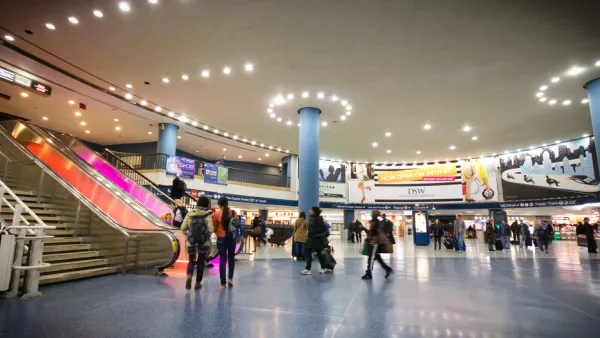
Post-Cuomo Penn Station Updates Could Move Project Forward
The controversial renovation of Penn Station could move forward with a scaled-back plan.

Massive, Expensive Redevelopment of Midtown Manhattan Proposed
New York Governor Cuomo's State of the State speeches last week included an ambitious proposal for a large-scale redevelopment project on Manhattan's west side, adjacent to Penn Station.

Planetizen Federal Action Tracker
A weekly monitor of how Trump’s orders and actions are impacting planners and planning in America.

The state-sanctioned urbicide of Austin
People don’t kill cities. Freeways do.

US to reduce Colorado River water deliveries to Mexico
A new Colorado Treaty amendment reduces Mexico’s Colorado River water allocation by 250,000 acre feet.

5 New England states march closer to 800 megawatt wind energy project
Securing federal approval for the project may be complicated under the Trump administration, which has historically been hostile towards domestic wind power.

Baltimore to break ground on $50 million Transit Priority Project
The project will bring faster bus trips, safer streets and better bike connections to Baltimore.

Airbnb launches $250 million 'last-dollar financing' housing accelerator, makes first investment in Austin
The company will put $6.4 million towards affordable housing development in Texas’ capital.

FREE Course: Walkable City 1: Why Walkability?
After describing his path towards focusing on walkability as the essence of good planning, Jeff Speck marches through his five principal reasons for making more walkable places.
Reinventing Malls: Planning Alchemy—Turning Gray Fields Into Gold
The course focuses on the opportunities and imperatives that shape reinvention of mall sites.

Eagle County Government
Harvard University Graduate School of Design
Nashville Planning Department
The Architects Foundation
University of Cincinnati Online
The Pocatello Development Authority
The Urban Renewal Agency of the City of Pocatello
Journal of the American Planning Association